

For two decades, Trita Parsi has been Washington’s go-to explainer for all things Iran. The “neutral” scholar. The voice of the Iranian American community. The reasonable man who only ever wanted diplomacy. He co-founded the Quincy Institute, ran the National Iranian American Council before that, and turns up in the New York Times, on the BBC, on MSNBC, and on Steve Bannon’s War Room, always saying a version of the same thing.
This week Jay Solomon at The Free Press reported that the State Department has opened an investigation into him and may try to revoke his green card and deport him. Cue the frame you already know. “A war critic, targeted.” “A dissenter, punished for his views.”
Trita Parsi runs the show at the Quincy Institute. But before that, he built and ran the National Iranian American Council (NIAC), and for fifteen years he has been one of the most quoted Iran analysts in Washington. The problem is that Parsi told us what he really was a long time ago.
He wrote it down. And a federal judge made him hand the paper over.
How the Documents Got Out
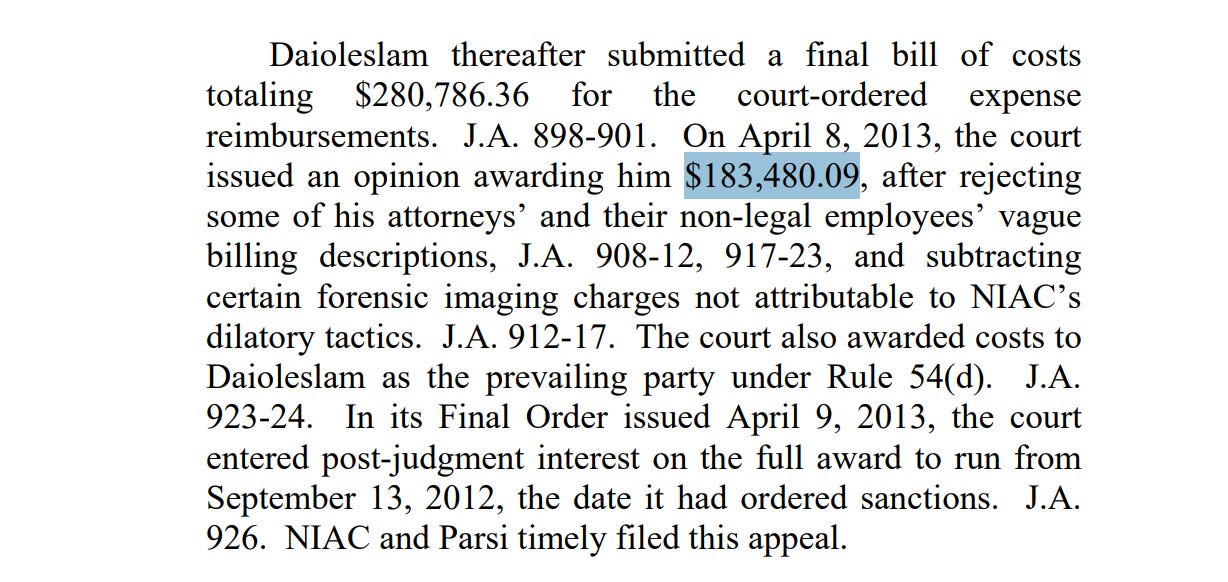
When NIAC sued the blogger Hassan Daioleslam for defamation in 2008, the discovery process forced thousands of internal NIAC records into the open. NIAC stonewalled and got caught. In 2012 Judge John Bates, a Bush appointee, dismissed the suit, and the courts later sanctioned NIAC and Parsi more than 183,000 dollars for discovery abuses. The D.C. Circuit affirmed the bulk of that award in 2015, while sending two smaller pieces back for reconsideration.
Bates was careful. He wrote that nothing in his opinion should be read as a finding that Daioleslam’s articles were true. Parsi lost on the narrow ground that he could not prove actual malice, the high bar a public figure has to clear. But Bates also wrote something the people who quote Parsi as a neutral source never mention. He wrote that Parsi’s occasional balanced statements were “not inconsistent with the idea that he was first and foremost an advocate for the regime.” A moderately intelligent agent for Tehran, the judge added, would not want to look unremittingly pro regime.
The Lobby He Named Himself
Start with the résumés, because Parsi wrote those.
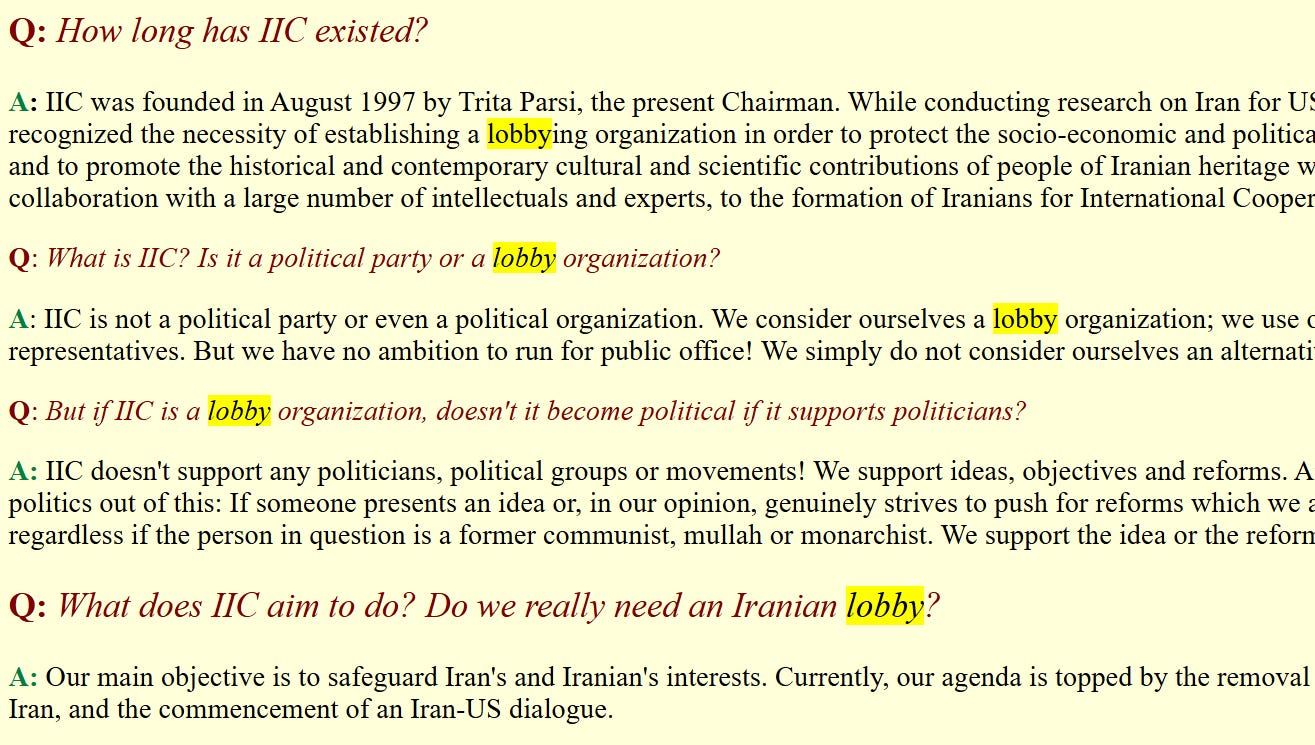
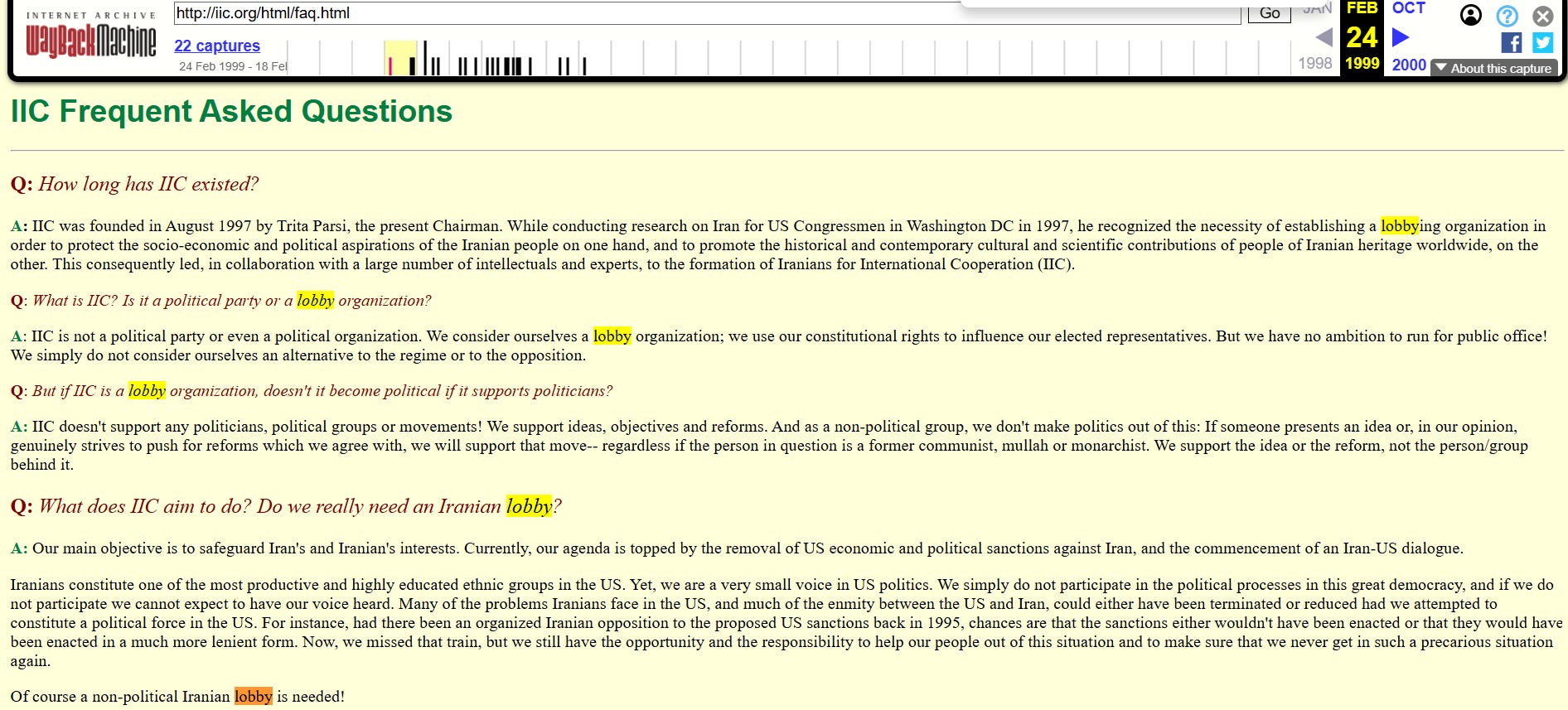
In 1997 Parsi founded a group called Iranians for International Cooperation (IIC), and it did not hide what it was. The public FAQ asked whether IIC was a political party or a lobby and answered plainly. The answer was a resounding hell yes. A whole section was headed around whether an Iranian lobby was needed, and the answer it gave itself was of course it is. This was not a line buried in one document. It was the public face of the group, and the page stayed up with the same language, captured over and over between 1999 and 2005. The stated mission was “to safeguard Iran’s and Iranian’s interests,” topped by lifting US sanctions.
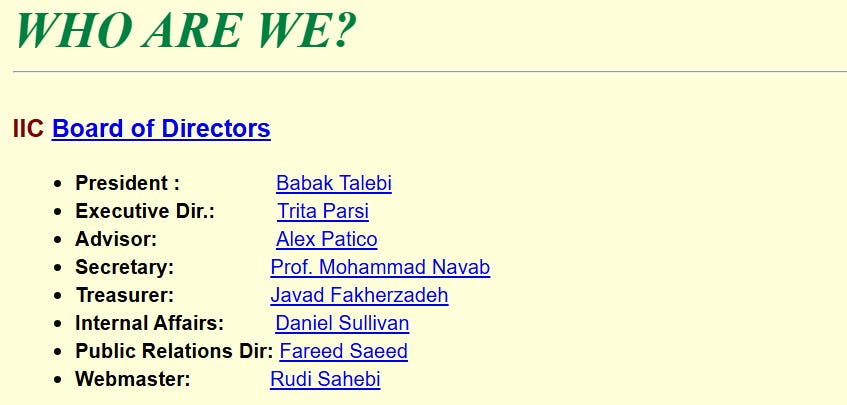
IIC and NIAC share some noticeable overlap in personnel. By 2000, the IIC board listed Parsi as executive director, Babak Talebi as president, and Alex Patico as an advisor. Two years later, all three were tied to the launch of NIAC. Both Talebi and Patico are listed as co-founders with Parsi. The new group (appeared to be) the old group with a cleaner name.
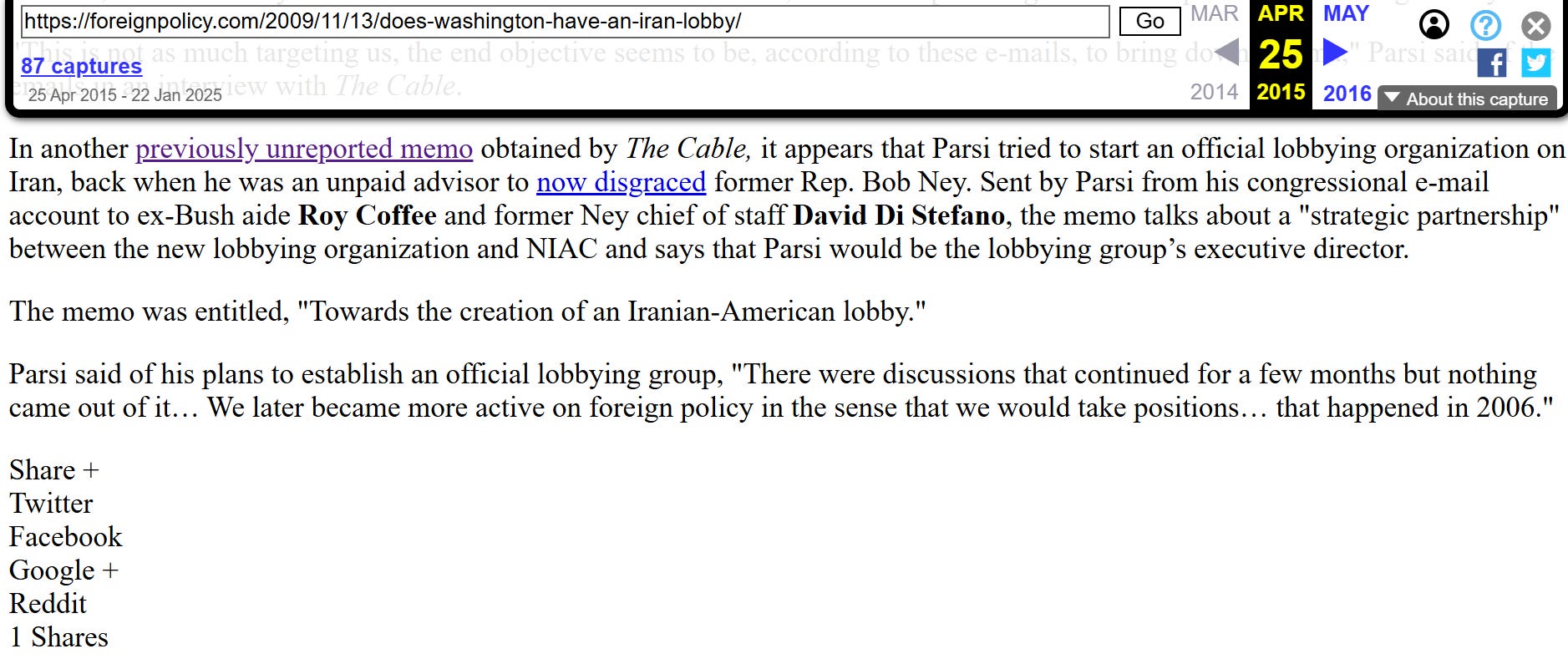
In a memo Parsi sent from his official Bob Ney congressional email account to Roy Coffee and Ney's former chief of staff David DiStefano, first reported by Josh Rogin at Foreign Policy, Parsi laid out plans for a new lobbying outfit in “strategic partnership“ with NIAC. NIAC would handle community education and the grassroots; the new group would “focus exclusively on lobbying activities on the Hill.”
It would model itself on AIPAC, Parsi explained. And it would have a proposed executive director already lined up, named in the memo: Trita Parsi. The title of the document was “Towards the creation of an Iranian-American lobby.” Parsi told Rogin the discussions went nowhere.
In other words, Parsi named himself executive director of an Iran lobby in writing.
The Patron Who Went to Prison
Parsi’s entry point to Washington was a congressman named Bob Ney. He first met Ney in 1991 as a high school exchange student in Ohio, when Ney was a state senator who had taught English in Iran and spoke Farsi. Ney reportedly took Parsi in after a falling out with his host family.
Ney is worth remembering for what he became. In 2007, he was sentenced to 30 months in federal prison. Part of what he admitted to was taking trips and gambling chips from Fouad al-Zayat, a Syrian born aviation businessman who wanted Ney’s help getting around a US law barring the export of American aircraft parts. That is the man who walked Parsi onto Capitol Hill.
Money From Tehran
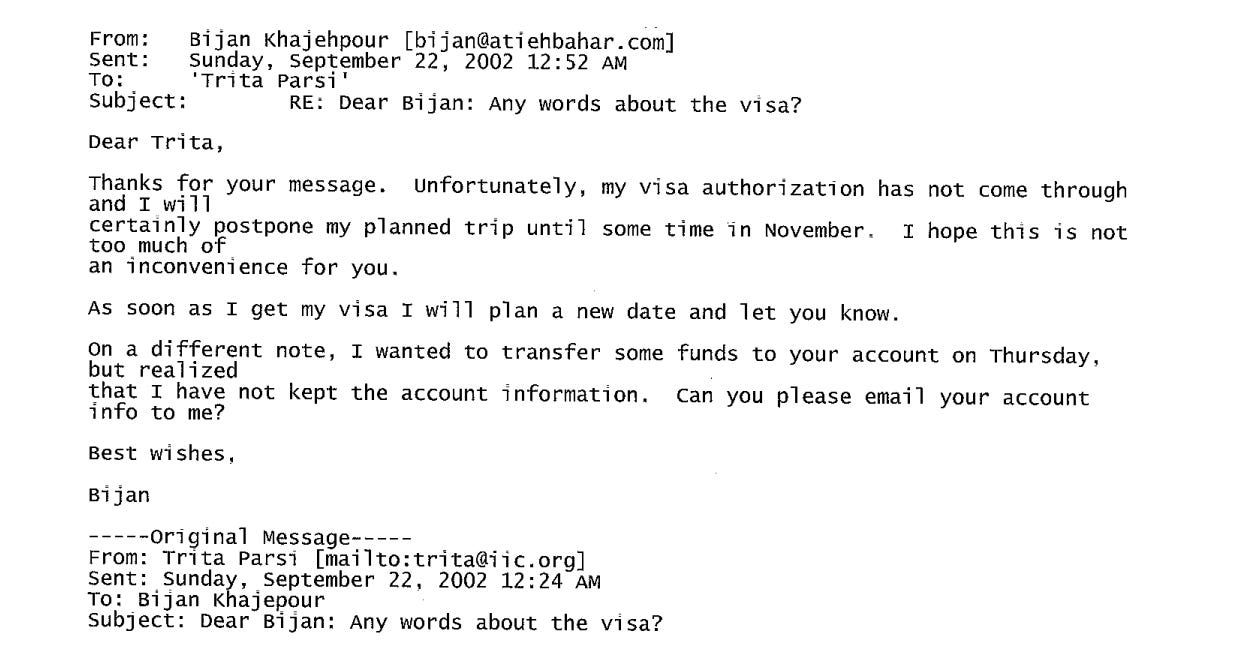
Parsi’s longtime collaborator was Siamak Namazi, who ran Atieh Bahar Consulting as its Managing Director — the consulting firm in Tehran that walked foreign oil majors into the Iranian market. Court-produced discovery documents include an Atieh Bahar political newsletter1 on US-Iran relations, described on its masthead as prepared by the firm’s “affiliate analyst in Washington, DC,” which NIAC produced under court order. They show Atieh Bahar’s Bijan Khajehpour writing to Parsi2 to say he wanted to transfer funds to his account and needed his bank details. And they show Namazi writing from Tehran3 to his Atieh Bahar assistant, instructing her to call a hotel in Jordan, and arrange a nice room with an Xbox or Playstation in it.
In December 2002, Parsi emailed4 the lobbyist Roy Coffee. He handed over the full contact details for Mohammad Javad Zarif, then Iran’s ambassador to the United Nations, and in the same message asked Coffee to find out who inside the Bush administration had drafted a statement on Iran. Coffee’s reply offered to go further: if Parsi had anything he wanted relayed to the statement writers for future use, Coffee would deliver it himself. By 2007 Parsi was sending Namazi written reports5 on the US Congress and AIPAC, on request, to Tehran. Namazi was sending talking points6 back the other way.
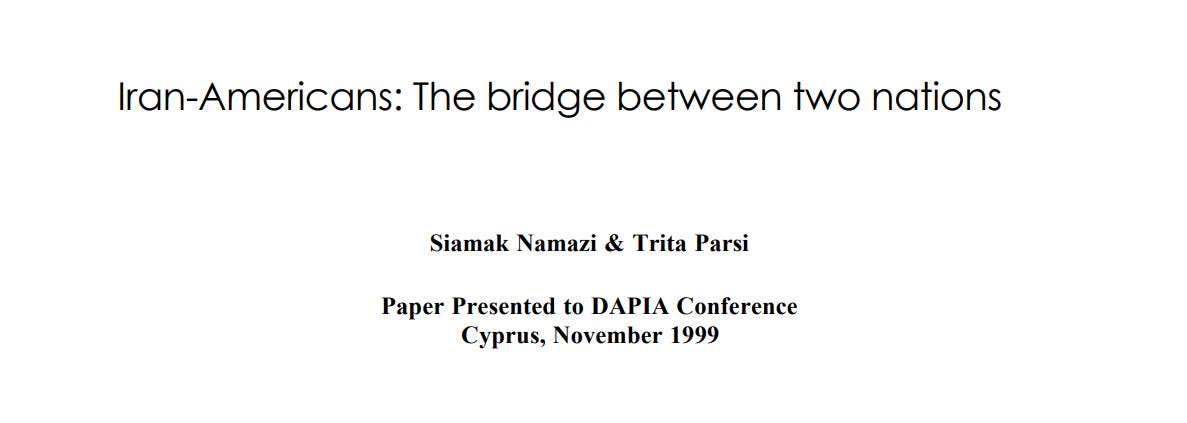
The 1999 paper Parsi and Namazi coauthored7 and presented at a conference in Cyprus is the thesis statement for all of it. It argues for building an Iranian American lobby modeled openly on AIPAC. The paper takes care to say this lobby would be different from one purely pursuing the Islamic Republic’s interests. Then it footnotes itself with interviews and correspondence Namazi conducted with the former head of Iran’s interest section in Washington, a director general at the Ministry of Culture, and an official at the Foreign Ministry.
Why This Matters Now
The reporting was done years ago, and done well. Eli Lake laid out the lobby story in the Washington Times in 2009. Josh Rogin covered it at Foreign Policy the same day. Tablet went back to it in 2017.
The work held up. What did not hold was everything after it. The rest of the establishment press decided Parsi was a respectable analyst, and the documents stopped getting read.
Even Hooshang Amirahmadi, the man who first hired Parsi in Washington and gave him his US visa, told Tablet that he introduced Parsi to Zarif and that “Zarif wanted this organization and he developed it.” Parsi has always denied that NIAC works for the regime.
Now that the State Department is reportedly looking into Parsi, the forthcoming media coverage will assuredly and uniformly portray him as it always has: A scholar. A war critic. A man targeted for his views.
But State isn’t looking into him for his views — but for his résumé. And the full record is not a leaked cache or a confidential source. It is documents a federal court already made public, written by Parsi, in his own hand. They have been sitting there the whole time. Washington just stopped following the trail.

Turns up in the NYT? So NYT conflict of interest jihadist links more probable to be found on the Shia side than MB side? For instance?
Just ran into you today (luckily, hi there), but as it happens, exactly at the moment the pieces on Arab infiltration (IRGC/twelvers/MB/Qatar/etc.) into western institutions start to fall in place. It's worse than we thought before and potentially worse than we're thinking now.
Any reading you recommend?