

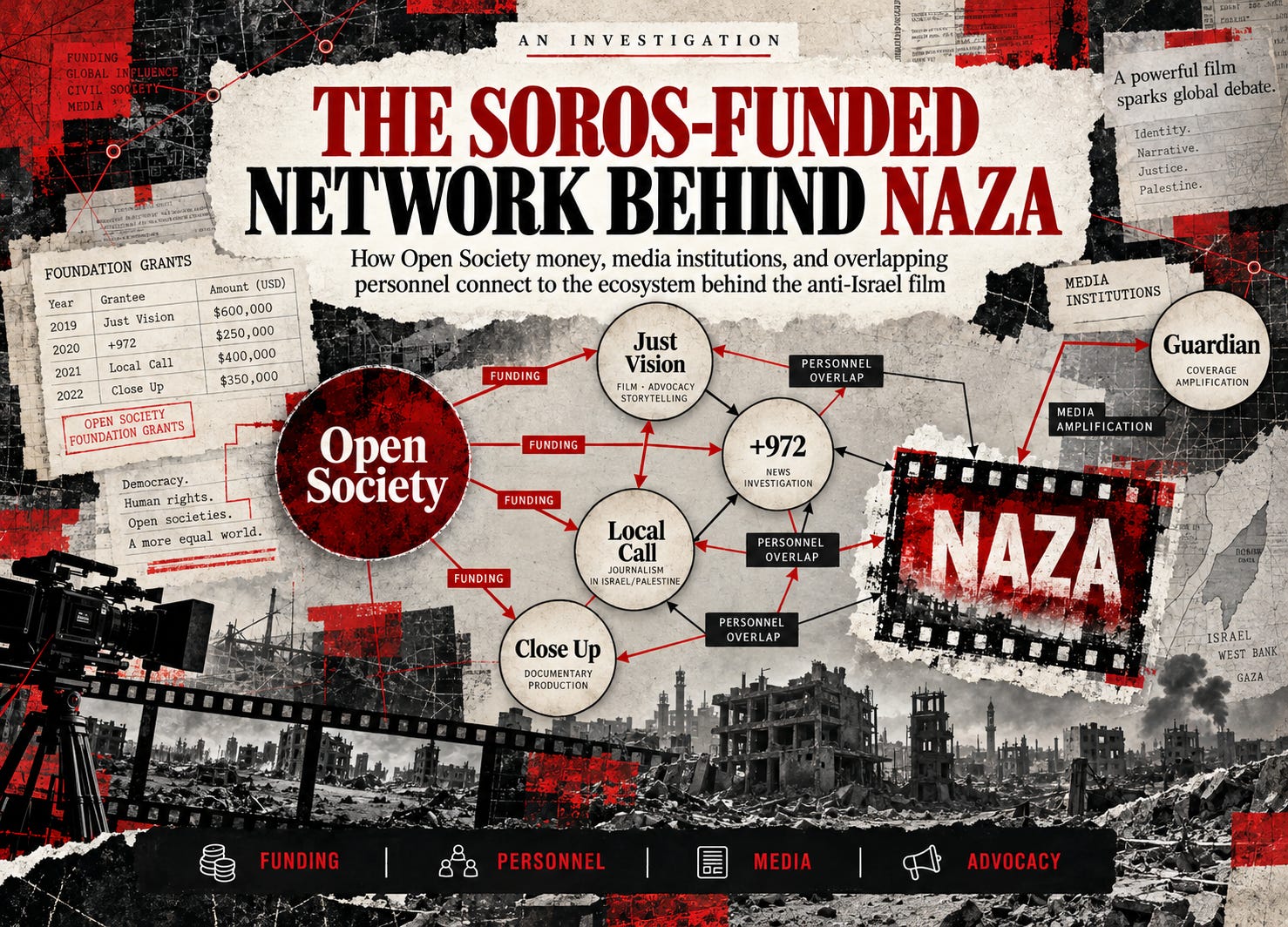
The anti-Israel documentary NAZA has received enormous international attention since winning the Special Jury Prize at the Venice Film Festival. Produced by the Guardian and JW Films, the documentary accuses Israel of systematically killing Palestinian civilians in Gaza.
But behind the film lies an extensive network of media organizations, foundations, and political activists, many with longstanding financial and personnel connections to the Soros family’s Open Society Foundations. My examination identified at least $2.05 million in Open Society grants to organizations within NAZA‘s reporting and publishing ecosystem, alongside multiple overlapping personnel connections involving Open Society veterans, major philanthropic donors, and individuals associated with the film’s development.
The findings don’t establish that Soros explicitly commissioned NAZA. Rather, they reveal a Soros-funded institutional ecosystem that helped sustain the journalism from which NAZA emerged.
Follow the money
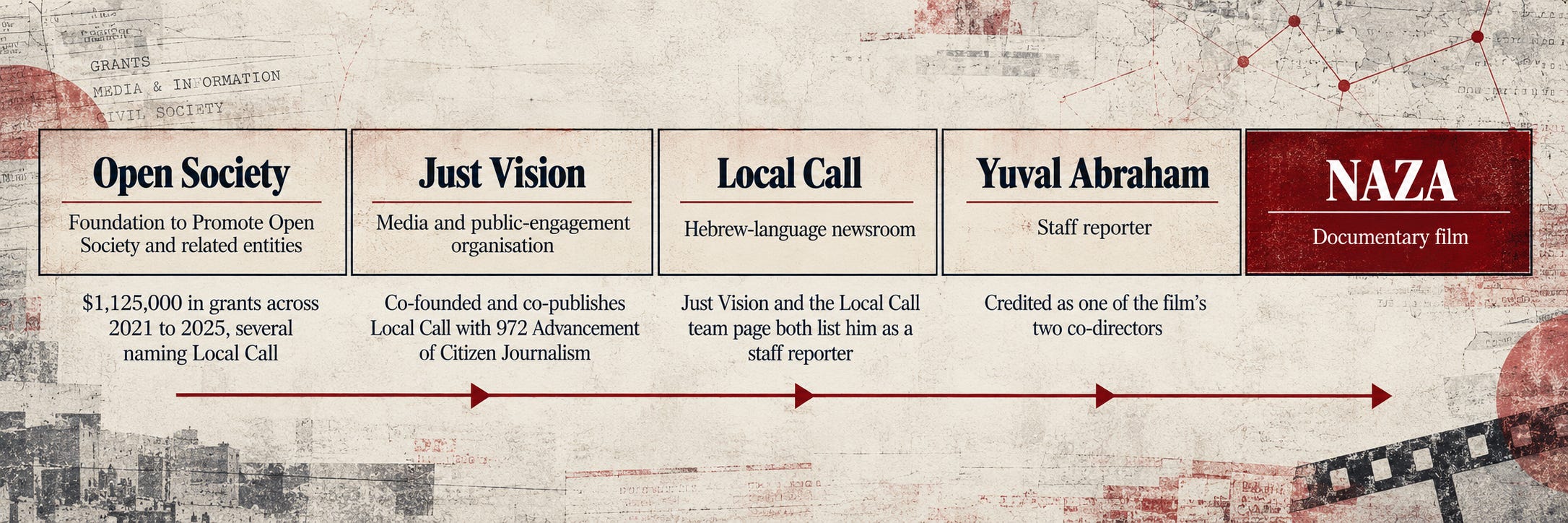
The clearest connection involves Just Vision, an American nonprofit that co-founded and co-publishes Local Call, the Hebrew-language publication employing NAZA co-director Yuval Abraham.
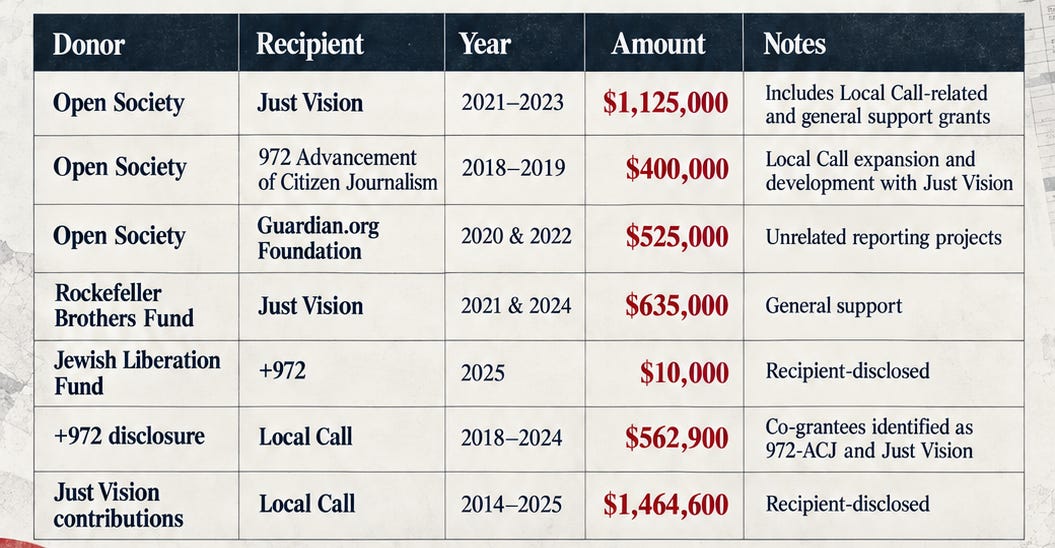
According to Open Society’s grant database, Just Vision received five grants totaling $1.125 million between 2021 and 2023.
Another $400,000 went to 972 Advancement of Citizen Journalism, which publishes +972 Magazine and jointly operates Local Call with Just Vision.
Several of these grants explicitly concerned Local Call’s development. In fact, +972’s own funding disclosures acknowledge years of Open Society support, identifying Just Vision and 972 Advancement of Citizen Journalism as co-grantees.
The institutional chain is clear:
Meanwhile, Open Society awarded another $525,000 to the Guardian.org Foundation, the philanthropic affiliate of the newspaper that produced NAZA. Those grants supported unrelated reporting projects, but establish a separate funding relationship with another institution associated with the documentary.
Altogether, the identified awards total $2.05 million.
Personnel connections
Following the money reveals only half the picture.
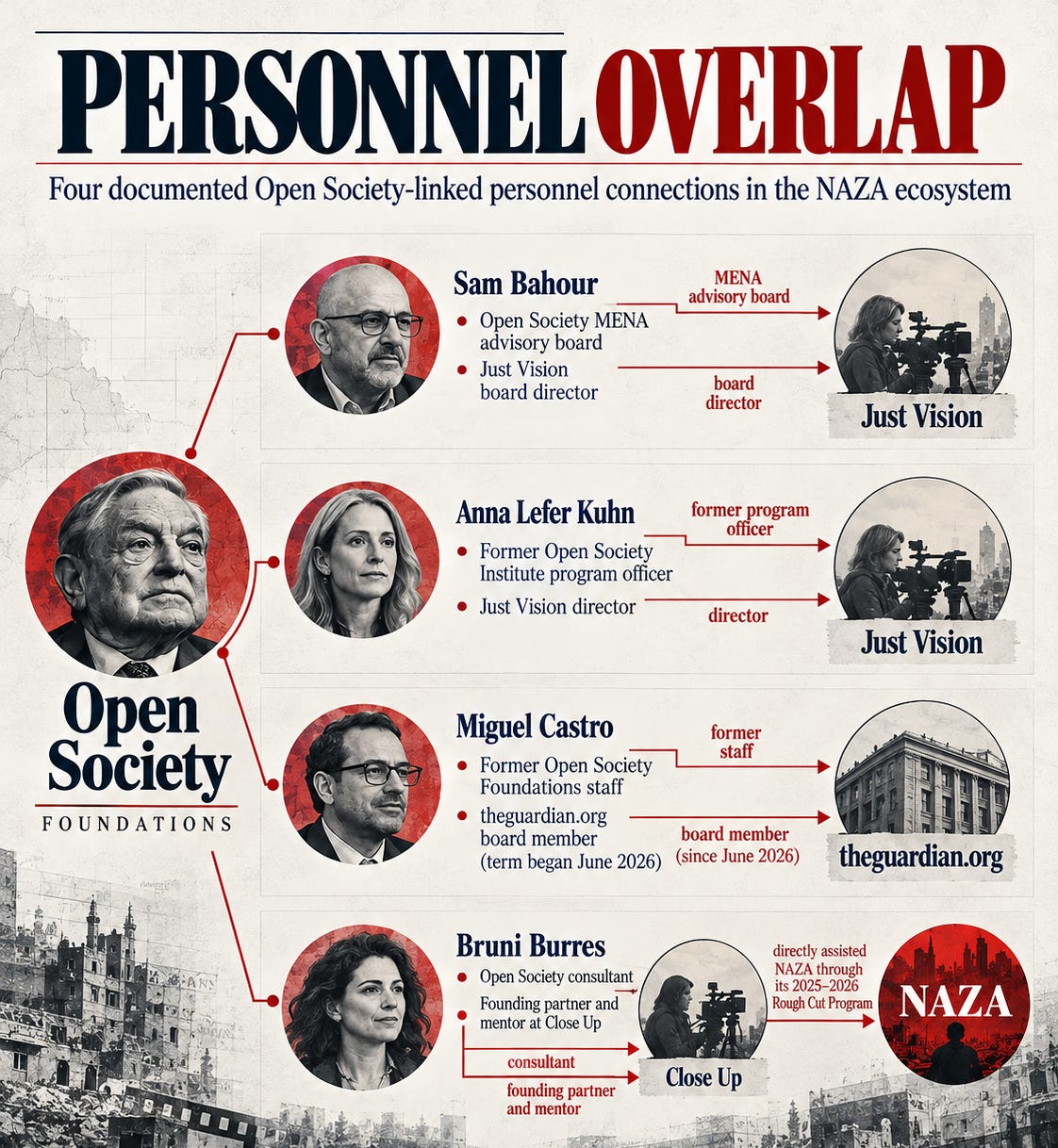
A further examination of nonprofit filings, historical employment records, and organizational biographies identifies several personnel overlaps:
Sam Bahour served on Open Society’s Middle East and North Africa advisory board while simultaneously serving on Just Vision’s board of directors.
Anna Lefer Kuhn, another Just Vision director, previously worked as a program officer at the Open Society Institute. Her employment appears in Open Society’s own historical staff records and in her professional bio.
Miguel Castro, who previously worked at Open Society Foundations, joined theguardian.org’s board in June 2026.
Bruni Burres, previously identified as an Open Society consultant, is a founding partner and mentor at Close Up, the documentary-development initiative that selected NAZA for its 2025–2026 Rough Cut Program.
An ecosystem with an explicit political agenda
The significance of these relationships becomes clearer when examining the ideological positions of figures within NAZA‘s reporting ecosystem.
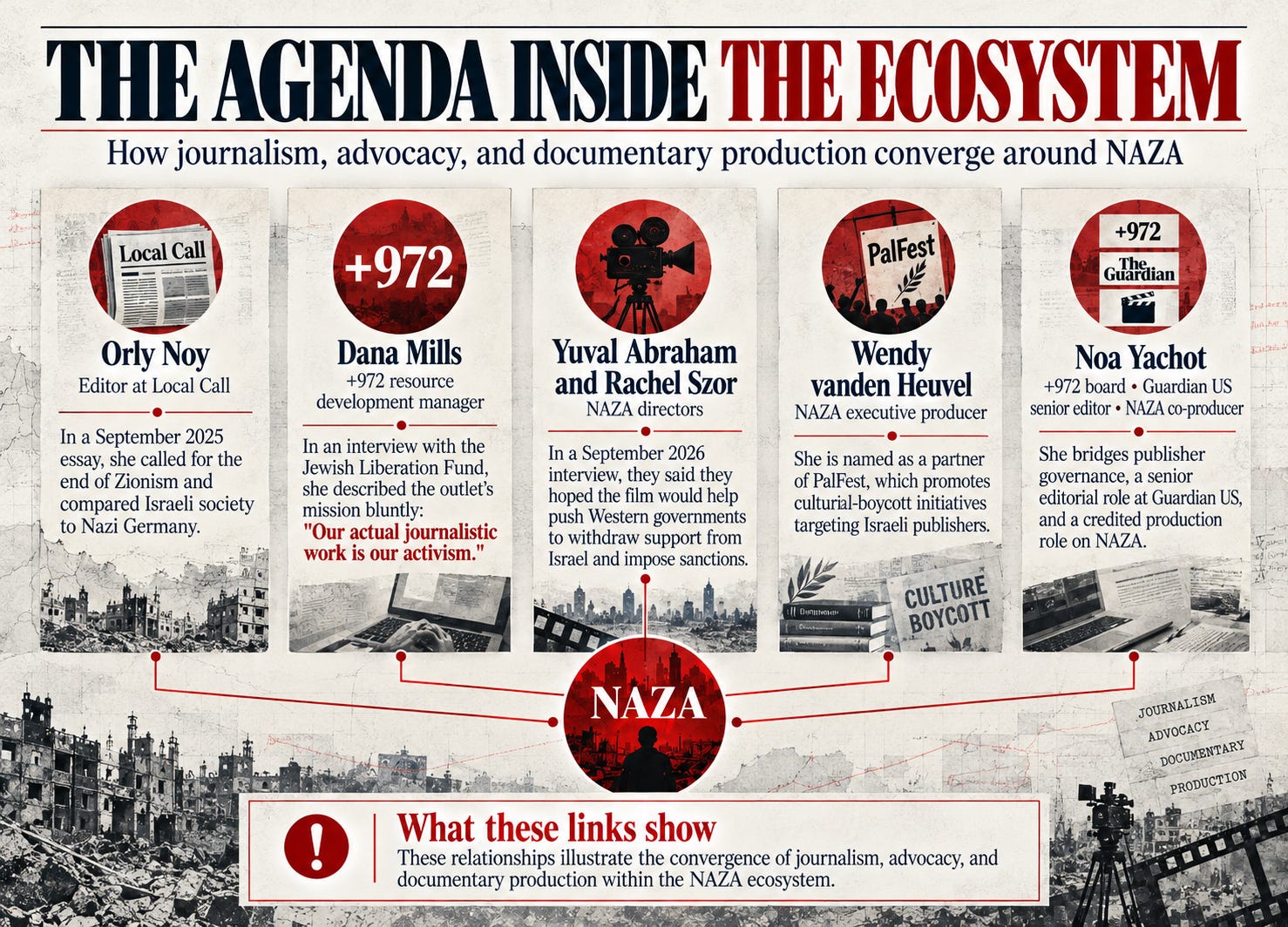
A recent Jewish Onliner investigation documented multiple examples. Orly Noy, an editor at Local Call, published a September 2025 essay demanding the end of Zionism and comparing Israeli society to Nazi Germany.
Meanwhile, +972 Magazine’s resource development manager, Dana Mills, acknowledged the publication’s activist mission in an interview with the Jewish Liberation Fund. “Our actual journalistic work is our activism,” Mills declared.
The political objectives extend to NAZA‘s own directors. In a September 2026 interview, Abraham and Rachel Szor told AFP they hoped the documentary would encourage Western governments to withdraw support from Israel and impose sanctions.
Wendy vanden Heuvel, an executive producer of NAZA, is named as a partner of PalFest, which promotes cultural-boycott initiatives targeting Israeli publishers.
And Noa Yachot simultaneously bridges +972 governance, her senior editorial position at Guardian US, and her credited role as a NAZA co-producer.
These relationships help explain the convergence of journalism, advocacy, and documentary production within the ecosystem.
The ecosystem is the point, stupid
Open Society is not simply a charitable foundation that accidentally wandered into the NAZA ecosystem. Soros has spent decades financing a political project explicitly designed to weaken the primacy of the nation-state, a political model that Israel embodies more unapologetically than any other Western democracy — which is why Open Society has funded numerous organizations involved in BDS, lawfare, apartheid campaigns, and efforts to isolate Israel internationally.
Open Society itself combines grantmaking with advocacy and strategic litigation, including campaigns directly challenging Israeli and American policy. NAZA’s directors, meanwhile, have openly said they hope their film will push Western governments to withdraw support from Israel and impose sanctions. The ideological convergence is not subtle.
That is what makes this investigation worthwhile. Open Society does not need to commission NAZA directly because, once enough money has been poured into an interconnected network of aligned newsrooms, activists, lawyers, filmmakers, and cultural institutions, the ecosystem eventually becomes self-sustaining. The journalism feeds the activism. The activism feeds the legal campaigns. The reporting becomes documentaries. The same personnel circulate among the institutions, while the same funders keep the infrastructure alive.
NAZA is a near-perfect case study.
No directive from Soros was necessary. The ecosystem had already been built to produce something like NAZA.
This text of this article was written with the help of A.I.
What always infuriated me about the ADL and other national Jewish orgs here in the US is that anytime anyone attacked Soros it suddenly became antisemitic. Its because these groups are aligned with the democratic party and Soros funded groups give heavily to democratic party candidates. We have been failed in so many ways by these self-appointed leaders.