

Over the past several weeks, I conducted what appears to be the first systematic, filing-by-filing analysis of every currently active Qatari foreign agent registered under the Foreign Agents Registration Act (FARA). I reviewed the Justice Department records for all 28 active registrants, then published a detailed examination of 23 of them in a continuous quote-tweet series on X.
The remaining five did not present the same immediately apparent red flags in the filings themselves. That does not mean their work is unproblematic; it simply means their filings do not flag the same patterns of discrepancy and extreme opacity.
The Full List
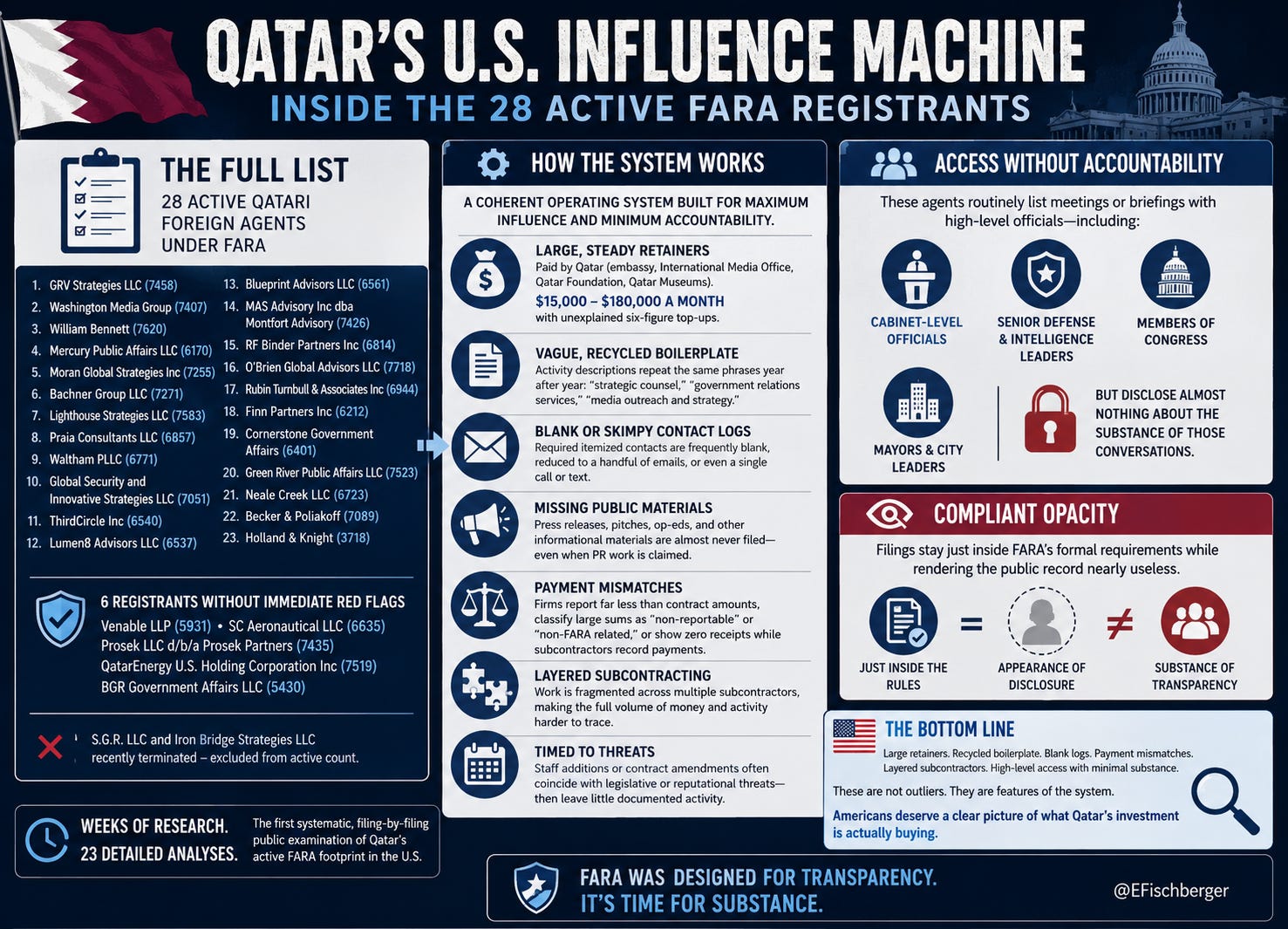
Here is the complete current list of active Qatari foreign agents, with registration numbers in parentheses. You can click the hyperlinks in each one to open their corresponding analysis.
GRV Strategies LLC (7458)
Washington Media Group (7407)
William Bennett (7620)
Mercury Public Affairs LLC (6170)
Moran Global Strategies Inc (7255)
Bachner Group LLC (7271)
Lighthouse Strategies LLC (7583)
Praia Consultants LLC (6857)
Waltham PLLC (6771)
ThirdCircle Inc (6540)
Lumen8 Advisors LLC (6537)
Blueprint Advisors LLC (6561)
RF Binder Partners Inc (6814)
O’Brien Global Advisors LLC (7718)
Finn Partners Inc (6212)
Neale Creek LLC (6723)
Becker & Poliakoff (7089)
Holland & Knight (3718)
The registered Qatari agents whose FARA filings did not present any immediately apparent red flags include Venable LLP (5931), SC Aeronautical LLC (6635), Prosek LLC d/b/a Prosek Partners (7435), QatarEnergy U.S. Holding Corporation Inc (7519), and BGR Government Affairs LLC (5430). The two FARA registrants whose contracts were recently terminated — S.G.R. LLC and Iron Bridge Strategies LLC —are excluded from the active count.
How the System Works
What emerges from the 23 agents I examined in detail is not a collection of isolated irregularities. It is a coherent operating system built for maximum influence and minimum accountability.
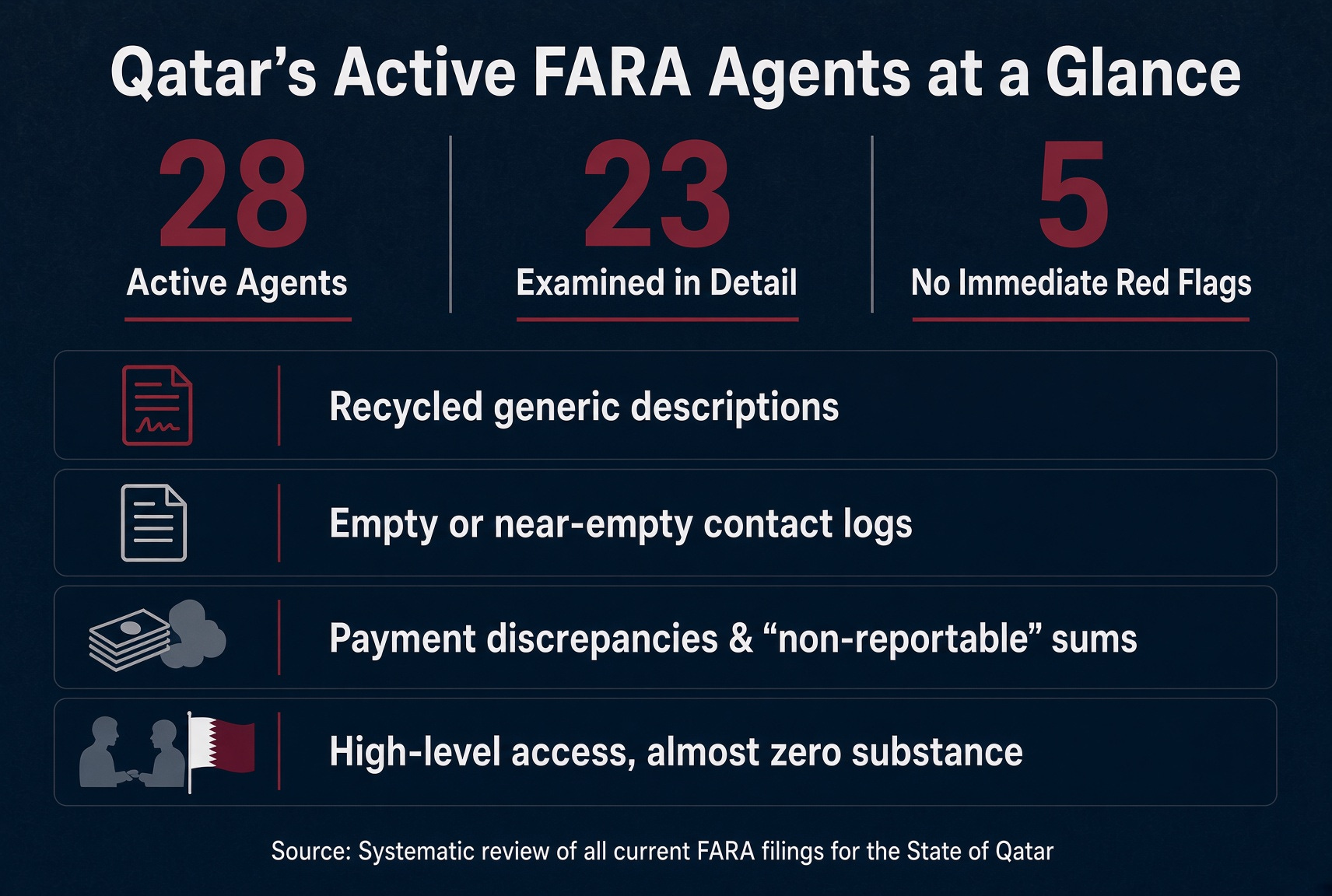
The model is straightforward. Qatar (through its embassy, International Media Office, Qatar Foundation, or Qatar Museums) pays large, steady retainers—ranging from $15,000 to $180,000 a month, sometimes with unexplained six-figure top-ups. In return, the public FARA record is kept deliberately thin.
Activity descriptions recycle the same vague boilerplate across firms and years: “strategic counsel and government relations services,” “advice and assistance to advance the bilateral relationship,” “media outreach and strategy.”
Required itemized contact logs are frequently blank, reduced to a handful of emails or meeting requests, or limited to a single phone call or text message. Informational materials—press releases, pitches, op-eds—are almost never filed even when the firm claims to be conducting public relations.
Payment records frequently do not match the underlying contracts. Firms report receiving far less than the agreed amounts, classify large sums as “non-reportable” or “non-FARA related,” or show zero receipts in the same periods that subcontractors record payments. Subcontracting itself is common, fragmenting the trail so that the full volume of work and money becomes harder to reconstruct. In several cases, staff additions or contract amendments appear timed to legislative or reputational threats, only to leave little documented activity afterward.
Access Without Accountability
At the same time, these agents routinely demonstrate high-level access. Filings list meetings or briefings with cabinet-level officials, senior intelligence and defense leaders, members of Congress, and mayors — while disclosing almost nothing about the substance of those conversations. The combination demonstrates enormous political and bureaucratic reach paired with near-total opacity about what that reach is actually purchasing.
Compliant Opacity
All this is very clearly by design. The filings stay just inside the formal requirements of the Foreign Agents Registration Act while rendering the public record nearly useless for understanding the real return on Qatar’s investment. FARA was designed so Americans could see what foreign governments are buying and from whom. In practice, for the vast majority of Qatar’s registered agents, the law currently delivers the appearance of disclosure without the substance.
Large retainers, recycled boilerplate, blank contact logs, payment mismatches, layered subcontractors, and high-level access with minimal substance are not outliers. They are features of the system. And the American public is entitled to a clearer picture of what that system is actually delivering.
Impressive essay which brings the receipts through careful research. Qatar knows how the American systems works and with its money has purchased influence in politics and academia. None of this bodes well for Israel, for Jews, or for America.
I keep reading about the Qatar influence. Thank you for these important specifics on the lengths to which Qatar goes to influence US policy while remaining obscure.