

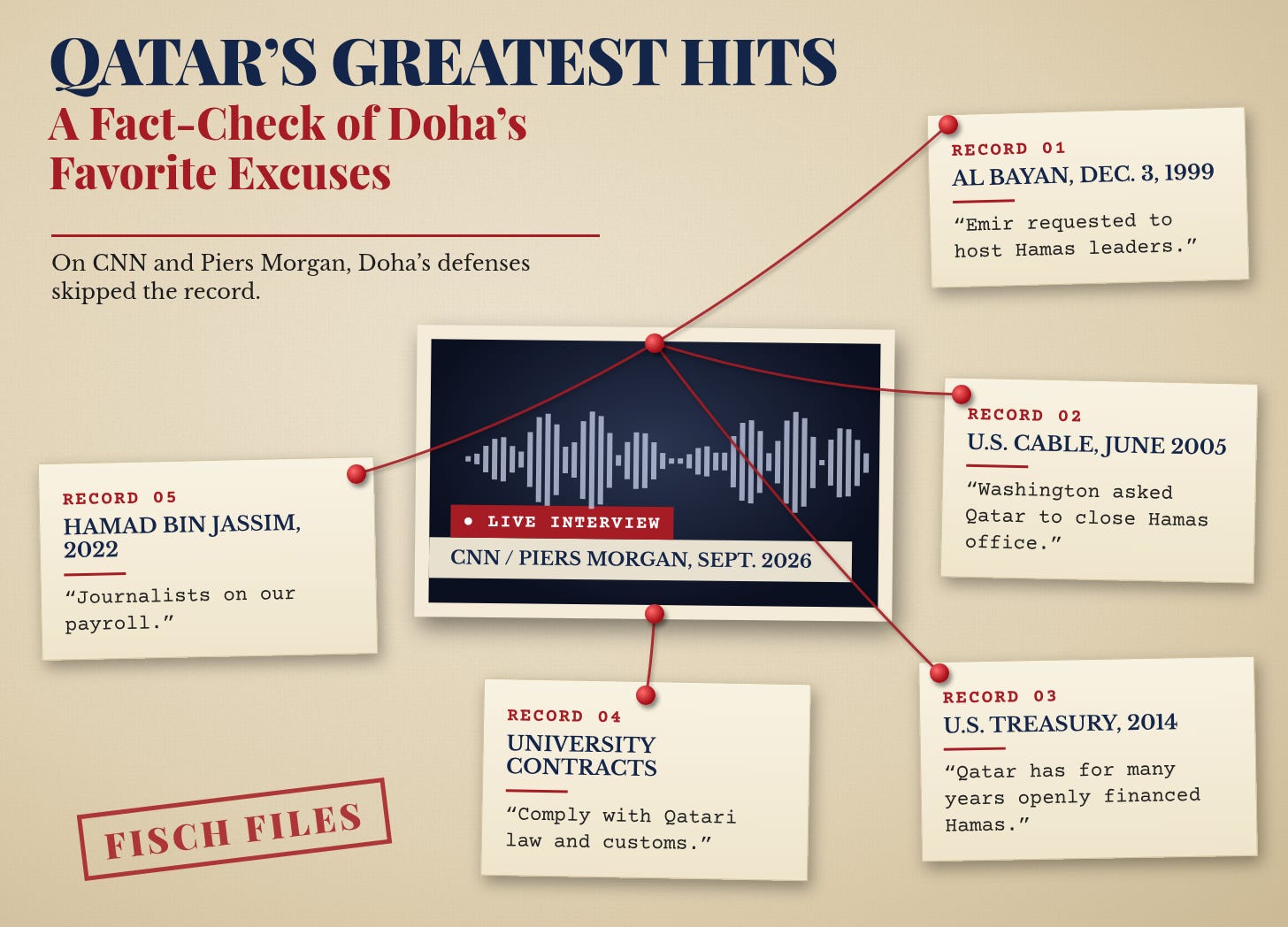
In September, Qatar’s Prime Minister, Sheikh Mohammed bin Abdulrahman Al Thani, appeared on CNN and Piers Morgan.
His message was familiar. Qatar hosted Hamas because Washington asked it to. Doha doesn’t finance Hamas’s military wing, support the Muslim Brotherhood, interfere with American universities, or pay journalists to advance its interests.
But Qatar’s own admissions, leaked diplomatic cables, and American government records tell a considerably more complicated story, to put it lightly.
Hamas Was in Qatar Long Before 2012
The prime minister said Qatar’s engagement with Hamas was undertaken at the request of the United States. But Qatar’s Hamas relationship was already well established.
On December 3, 1999, Qatar’s foreign minister, Hamad bin Jassim Al Thani, explained that Qatar’s emir had requested Jordan’s king to allow expelled Hamas leaders to relocate to Doha.


Crucially, the foreign minister said Washington hadn’t arranged the move. America was notified only a day before their arrival, and Qatar hadn’t sought its approval.
Then, in June 2005, U.S. homeland security adviser Frances Fragos Townsend asked Qatar to close what Washington described as a Hamas office in Doha.


So yes, Washington supported the later 2012 political bureau arrangement. But it neither initiated Qatar’s earlier hospitality toward Hamas leaders nor consistently welcomed their presence.
And What About Financing Hamas?
Al Thani insisted Qatar hadn’t financed Hamas’s military wing, emphasizing civilian payments to Gaza made with Israeli approval.
But in March 2014, U.S. Treasury undersecretary David Cohen stated that Qatar had openly financed Hamas for years.
A December 2009 U.S. diplomatic cable also recorded concerns about assistance reaching Hamas through Qatari charitable organizations, alongside the emir’s pledge to support whichever Palestinian faction won elections.

The Muslim Brotherhood Relationship
In 2017, Qatar’s foreign minister asserted that Qatar “does not support Hamas or the Muslim Brotherhood,” that Qatar doesn’t support the Muslim Brotherhood, and that no Brotherhood members were present in Qatar.
This is utter nonsense. Let’s look at just one example showing how.
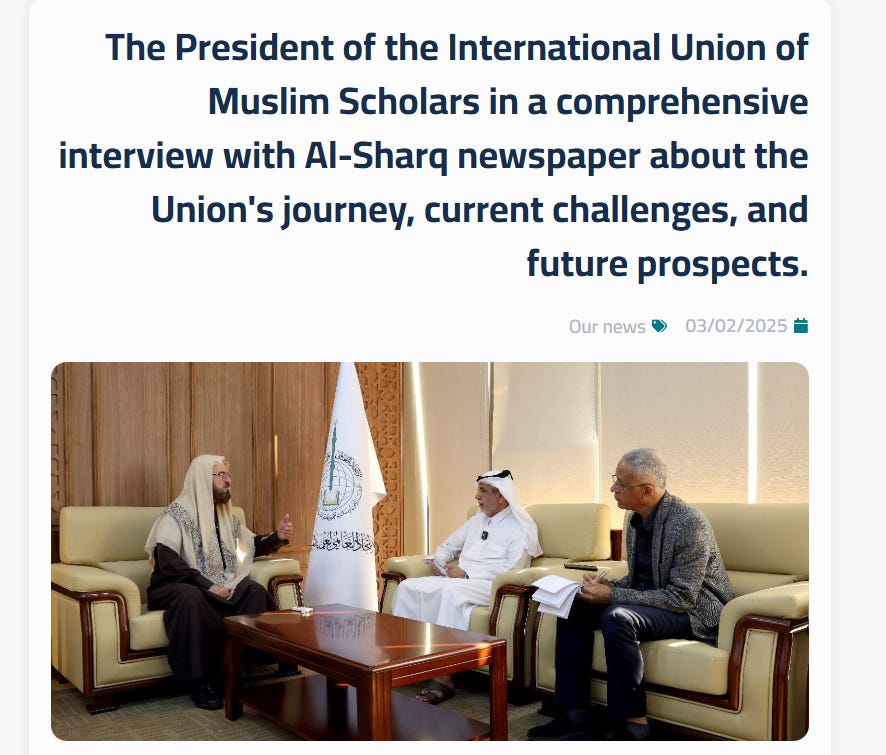
Doha has long hosted the International Union of Muslim Scholars, founded by Yusuf al-Qaradawi, the Brotherhood’s spiritual leader. The IUMS is the Brotherhood’s international religious authority.
In a February 2025 interview, the IUMS’ current president, Ali al-Qaradaghi, described how Qatar’s former emir helped secure its legal recognition and the current emir backed its headquarters. Qaradaghi named Qatar and Turkey as its largest supporters.
American Universities, Qatari Rules
Al Thani also insisted Qatari funding to American higher education doesn’t interfere with American universities, stressing that it largely supports the Western campuses in Doha. But the agreements expose qualifications absent from that reassurance.
A 2026 U.S. House committee report quoted agreements requiring both Georgetown and Northwestern’s Qatar campuses to comply with Qatari law and respect the country’s cultural, religious, and social customs.
In 2020, Northwestern moved a planned talk involving the Lebanese band Mashrou' Leila, whose lead singer was openly gay, from Doha after backlash. Northwestern cited safety concerns, but Qatar Foundation, contradicting Northwestern, said the event conflicted with Qatari laws and customs.
Following October 7, 2023, Qatar Foundation asked communications teams across its American partner campuses to remain “aligned and in touch” and route proposed communications to government entities through the foundation for advice.
Georgetown’s relationship raises questions beyond Doha. A $630,000 Qatari Foreign Ministry grant to its Bridge Initiative required it to consult a ministry-supported initiative on conference sessions, themes, and speakers, including for events in Washington, D.C.
A separate Carnegie Mellon agreement required consultation with Qatar Foundation on leadership appointments and course changes.

The Former Prime Minister’s Journalists Admission
Al Thani dismissed allegations that Qatar pays journalists or influencers to advance its agenda. Yet former prime minister Hamad bin Jassim acknowledged in 2022 that journalists in multiple countries had been on Qatar’s payroll, with some receiving a monthly salary. Some, he added, later became parliamentarians.


A Much Longer History
In 1999, Qatar’s emir personally invited Hamas leaders to Doha, and Washington found out a day before they landed.
In 2005, the White House asked Qatar to shut down a Hamas office there.
In 2014, the U.S. Treasury said Qatar had “openly financed Hamas” for years.
Doha hosts the Brotherhood’s religious authority that its own emir helped build. It signs contracts binding American universities to Qatari law. And its former prime minister admitted journalists in multiple countries were on its payroll.
Qatar’s prime minister mentioned none of this on CNN or Piers Morgan.
Qatar’s tried and true strategy is to repeat these polished talking points, and count on friendly interviewers not to push back. But I’m not that friendly.
This article was written with the help of AI