

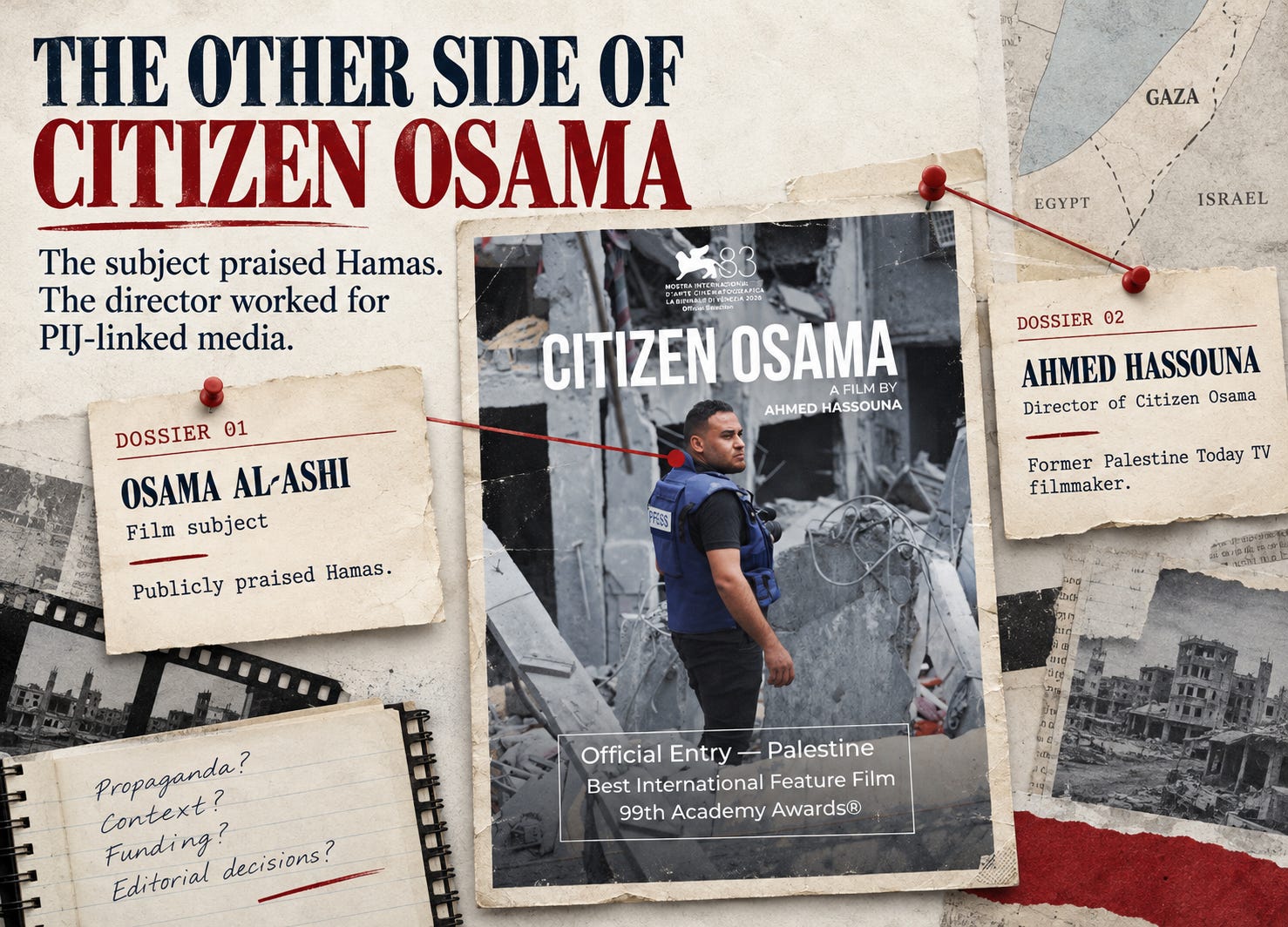
Citizen Osama is being sold to audiences as an intimate story of survival: a Gaza photographer trying to care for his newborn son while documenting a devastating war. On August 31, 2026, the Palestinian Ministry of Culture announced that the documentary had been selected as Palestine’s entry for Best International Feature Film at the 99th Academy Awards.
But the film’s publicity leaves out a significant part of both its subject’s and its director’s history.
The film’s protagonist, Gaza photographer Osama Al-Ashi, publicly thanked Hamas on X in 2016, shared images glorifying Palestinian terrorism, and gushed over Hamas founder Ahmed Yassin. Its director, Ahmed Hassouna, worked as a director and photographer at Palestine Today TV — a channel operated by the Islamic Jihad terrorist organization.
The Oscar story
The documentary premiered at the Venice Film Festival in September. Its official Venice listing names Al-Ashi as the film’s central subject and Hassouna as director and cinematographer, and introduces Al-Ashi as an artistic photographer turned wartime documentarian focused on family, loss, and perseverance. Since then, the film has entered the international festival circuit, including a festival screening that highlights its Academy submission, and on October 11, anti-Zionist outlet Mondoweiss published a sympathetic account of the film’s approach.
Al-Ashi’s earlier archive
Al-Ashi’s full Arabic name is Osama Suhaib Al-Ashi. In a May 2025 testimony collected by the Palestinian media-rights organization MADA, he identified himself as director of Wide Media for Media Production. PBS FRONTLINE lists him under Gaza production for A Year of War: Israelis and Palestinians. His work was also credited on the Channel 4 documentary Gaza: Doctors Under Attack.
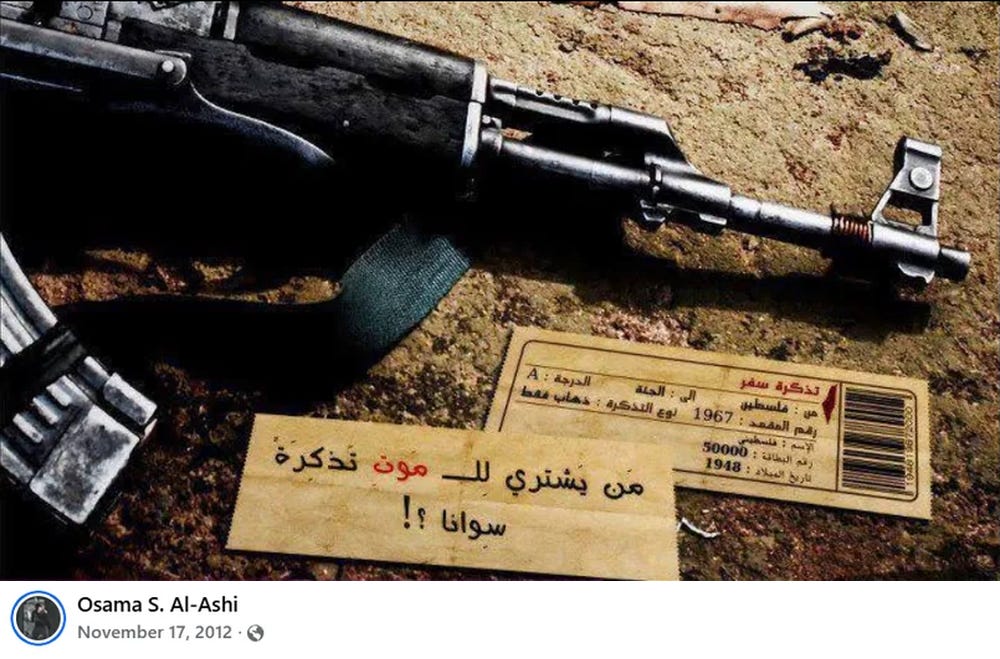
I found posts from his Facebook page, which show a very different side of his public persona. In November 2012, Al-Ashi posted an image of a rifle beside a mock travel ticket, with Arabic text asking who else would buy a “ticket to death.”
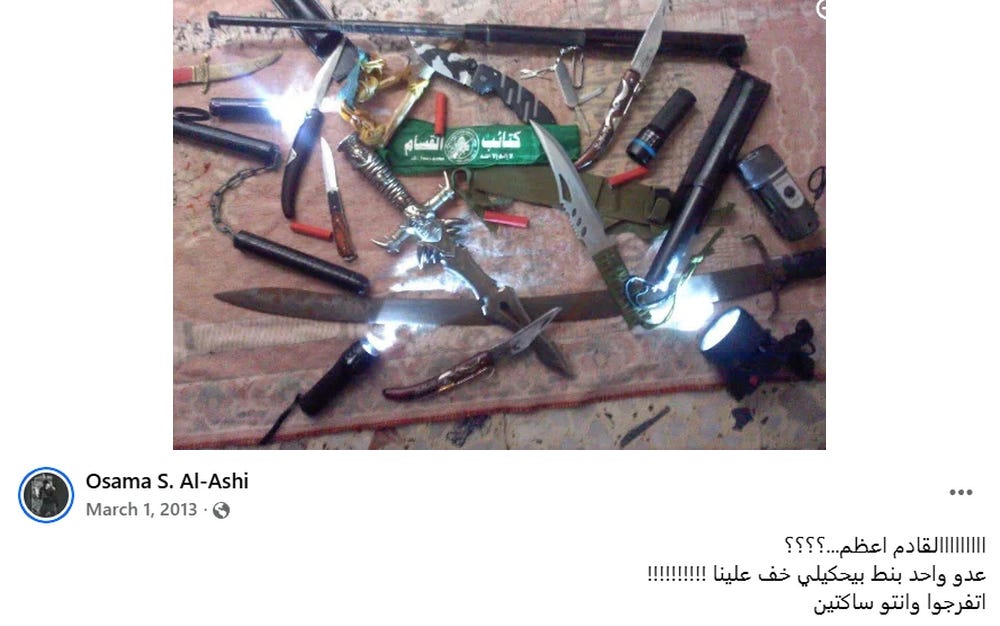
In March 2013, he posted a photograph of a green headband bearing the name of Hamas’s Izz ad-Din al-Qassam Brigades, surrounded by knives, blades, batons, and improvised gear. His Arabic caption declared that “what’s coming will be greater” and told detractors to watch in silence.
In April 2014, he posted a photograph of an armed man he identified as “Martyr Musab Daghmash,” with hearts and a request to pray for mercy for him. Later that month, he posted a graphic bearing the Hebrew words “Death to Israel.” An August 2014 post featured an armed terrorist beside the al-Qassam Brigades emblem.


“Thank you, Hamas”
On August 5, 2016 Al-Ashi praised Hamas on X, referring to the terror group as “resistance” and added the hashtag #ThankYouHamas. The original post can still be viewed directly.

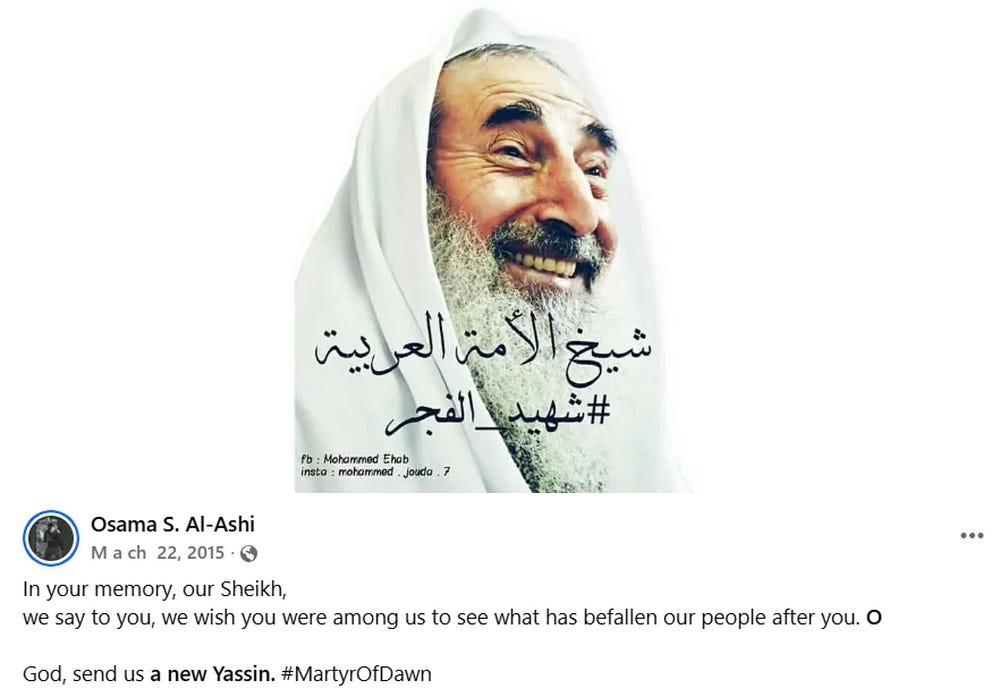
In a March 2015 Facebook tribute to Hamas founder Ahmed Yassin, Al-Ashi described Yassin in reverential terms and wrote: “God, send us a new Yassin.”
Al-Ashi’s connections to Hamas’s leadership go back years. In December 2014, he shared a Safa News Agency item about a young Gazan — Osama himself — taking a selfie with Hamas leader Ismail Haniyeh.
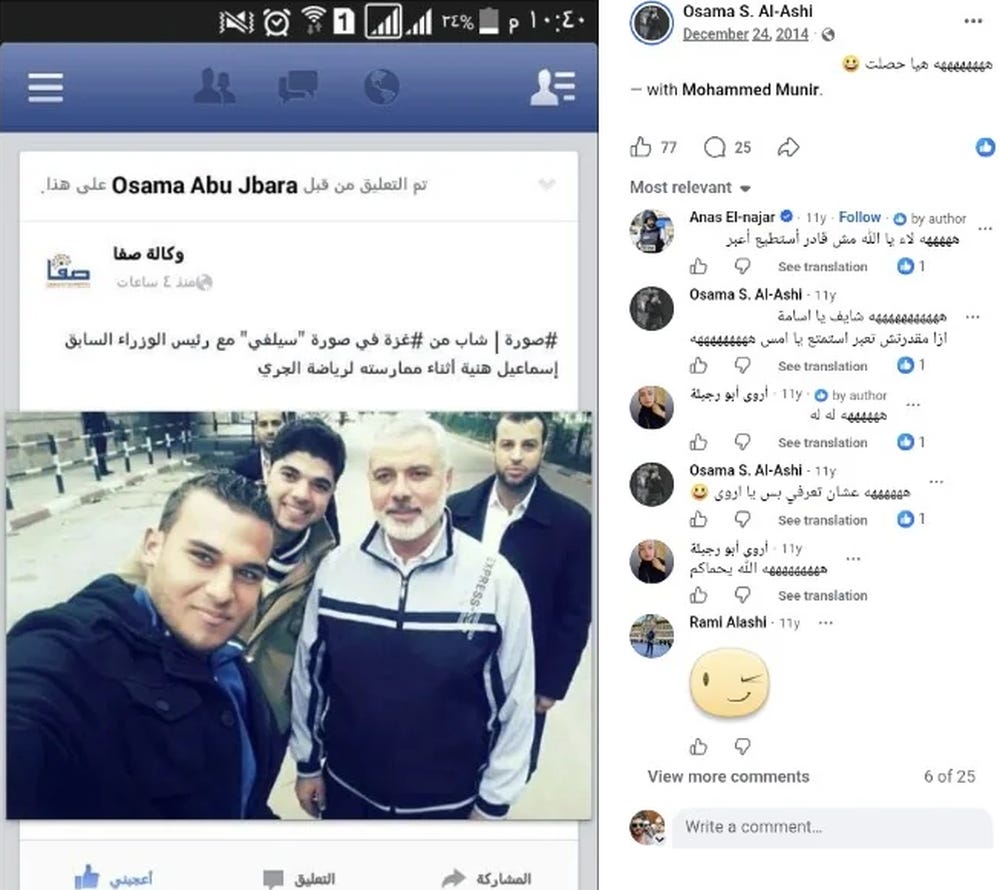
More recently, media watchdog CAMERA-UK reported that Al-Ashi praised Khairi Alqam, the gunman in the January 2023 Jerusalem synagogue attack that killed seven people, as a “martyr.”
October 7
On October 7, 2023, Al-Ashi’s Facebook page carried footage of men riding an Israeli military vehicle through the Al-Rimal area of Gaza City. The caption identified the vehicle and the location.
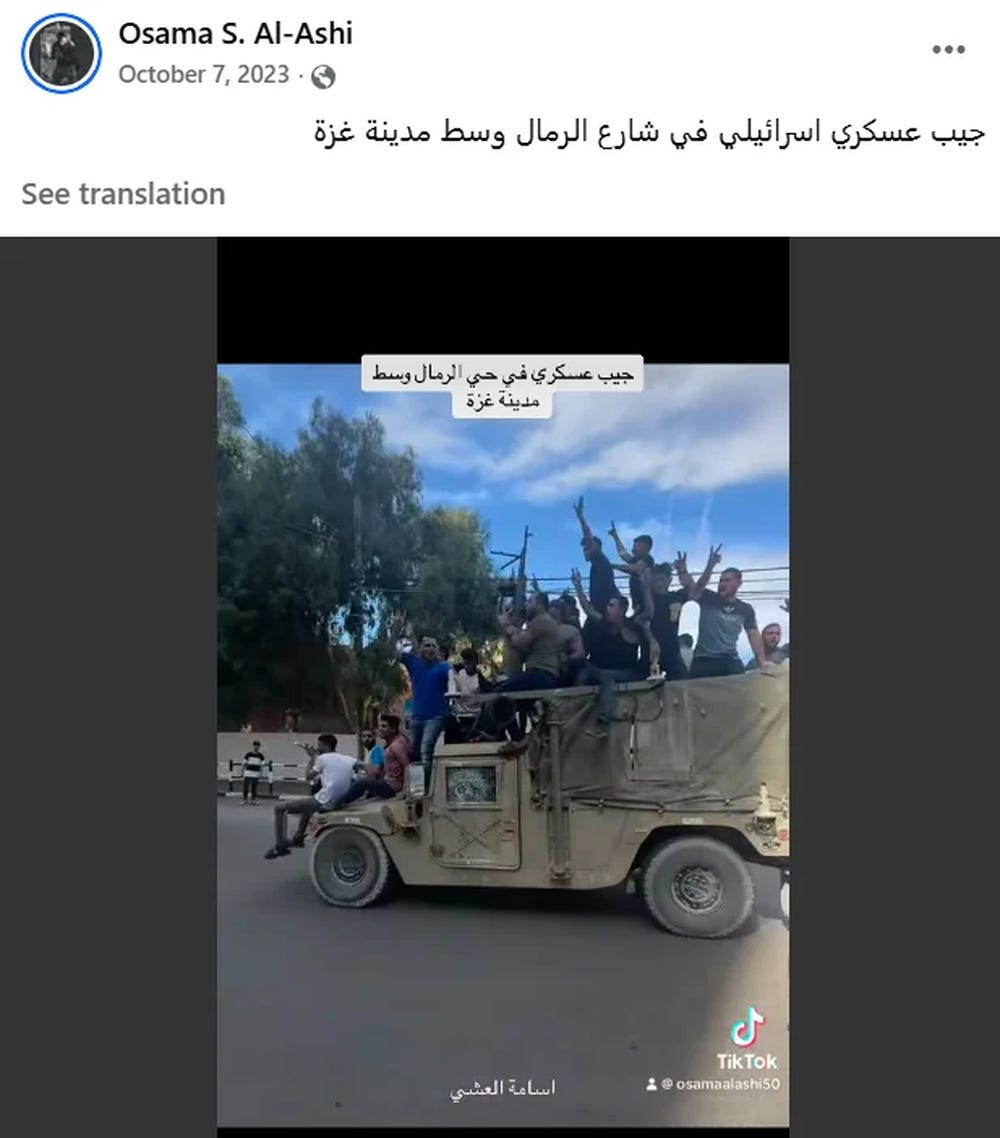
In a September 2026 investigation, German journalist Wolfgang Tietze went considerably further. Tietze alleged that a group around Al-Ashi and Wide Media operated near Al-Shifa Hospital as Israeli hostages were brought into Gaza, and argued that filming locations and the timing of publication point to advance coordination.
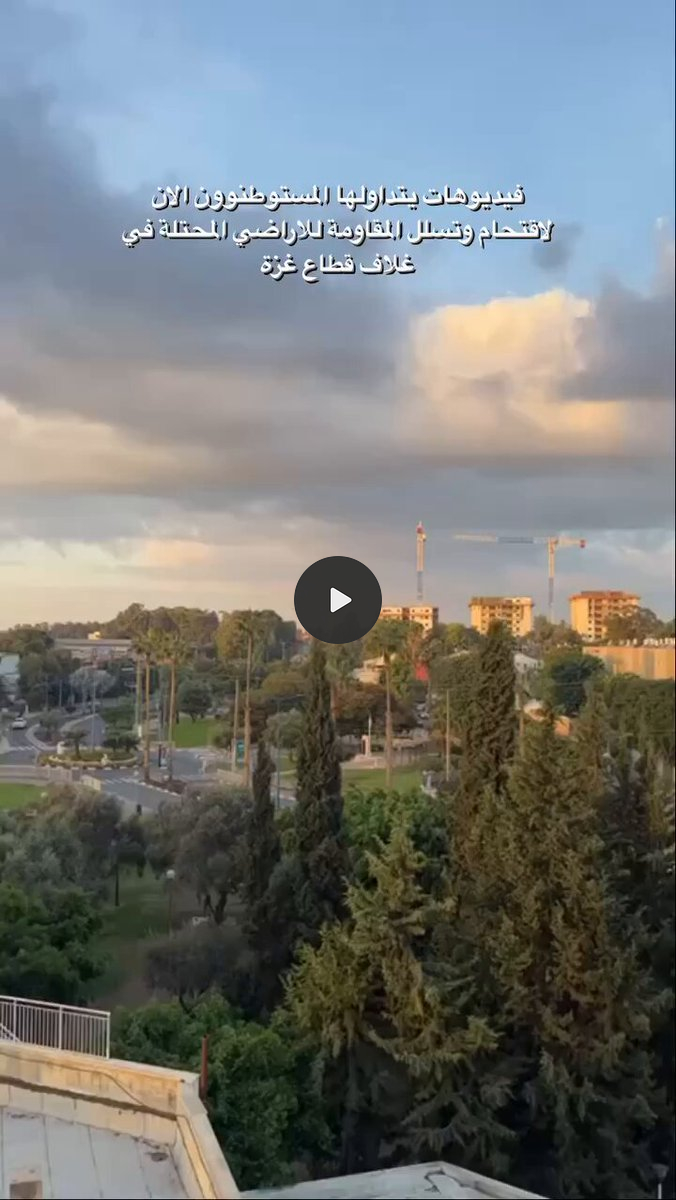
Additionally, CAMERA Arabic highlighted several of Al-Ashi’s Instagram reels, in which he reacts enthusiastically over the news of the unfolding carnage on October 7th.

The director’s years at Palestine Today TV
The director of Citizen Osama’s full name is Ahmed Khamis Hassouna, according to Al Jazeera in 2014. Born in 1984 and raised in Gaza, he studied journalism at Al-Azhar University before moving into documentary and narrative film. His earlier work includes the documentary Broken Strings (2014), the feature Istrupya, and Sorry, Cinema, his short in the 2024 anthology From Ground Zero.
That résumé leaves out that Hassouna previously worked for Islamic Jihad’s Palestine Today TV. Here, the evidence isn’t a Facebook post or a disputed photograph. It’s a professional record spanning several years, including the broadcaster’s own acknowledgement of his work:
A December 2012 Hamas Government Media Office photographer roster lists “Ahmed Hassouna” as number 84 under Palestine Today TV.
A November 2014 interview described him as a director from Gaza “working at Palestine Today TV.”
An article in The New Arab identifies his film Broken Strings as produced by Palestine Today TV, and a 2014 report in Qatar’s Al-Arab pairs his full name with Palestine Today TV production.
In a December 2023 retrospective, the channel itself called Hassouna one of its directors and credited his 2014 and 2015 awards.

What Palestine Today TV really is
Palestine Today TV is quite literally run by Palestinian Islamic Jihad.
In 2021, Lebanon’s Al-Akhbar explicitly identified Islamic Jihad as the channel’s “official sponsor,” reporting that the organization’s leadership was involved in efforts to keep the financially troubled station operating. Three years earlier, Al-Modon reported that financial problems affecting Islamic Jihad had left the channel’s employees unpaid for nearly two months, and that the group’s leadership was considering relocating the station from Beirut to Gaza to reduce costs.
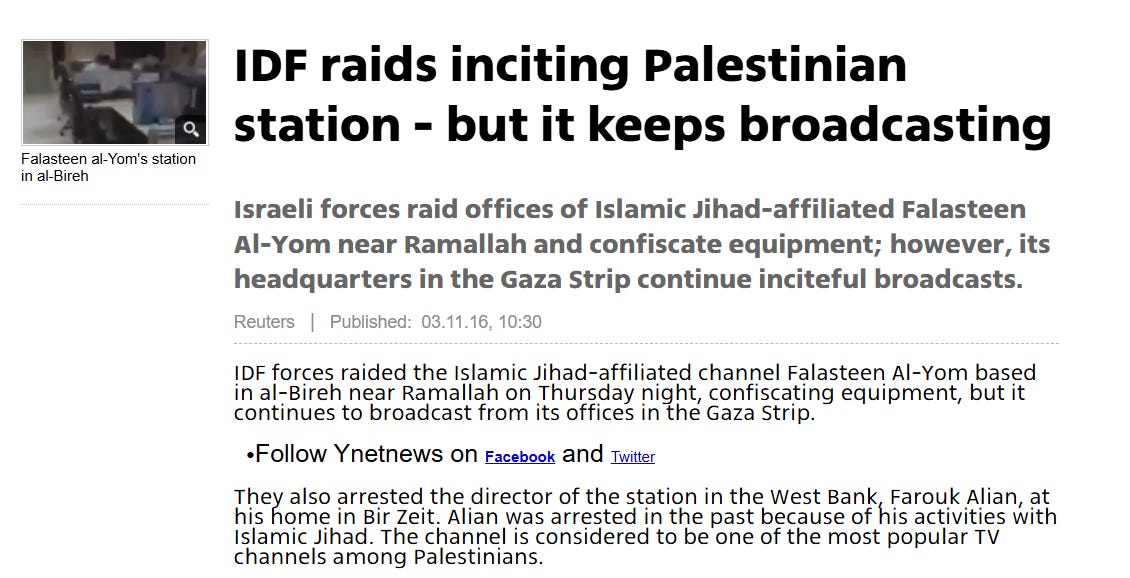
In March 2016, Israeli authorities raided the channel’s West Bank offices, accusing it of inciting terrorist attacks. Both Reuters and the Associated Press identified the broadcaster as Islamic Jihad-affiliated, a characterization repeated by the Committee to Protect Journalists as recently as June 2025.
An Oscar for Supporting Terrorism?
As Citizen Osama makes its way through the international festival circuit, audiences are being introduced to a courageous Palestinian photographer documenting the horrors of war. What they’re not being shown is the same man’s years-long record of glorifying Hamas, celebrating terrorists, and sharing imagery associated with its military wing.
Nor are they being told that the filmmaker behind this supposedly intimate human portrait previously worked as a director for a television network sponsored by Islamic Jihad, producing films for the terrorist organization’s media apparatus.
Palestinians have chosen Citizen Osama to represent it at the Oscars. The least the international film industry can do is examine who, exactly, are the people behind the film.
This article was written with the help of AI.