

Key facts
On November 19, 2026, the Dutch NGO Free Press Unlimited (FPU) published From Tagging to Targeting, a report on Al Jazeera’s Anas Al-Sharif and Hossam Shabat, two Gaza “journalists” killed by Israel in August 2025 and March 2025. The report argues that a “network” of Israeli officials and independent actors built the terrorism allegations against them, and that those allegations were “repeated after their deaths to justify their killing by the IDF” (p. 69).
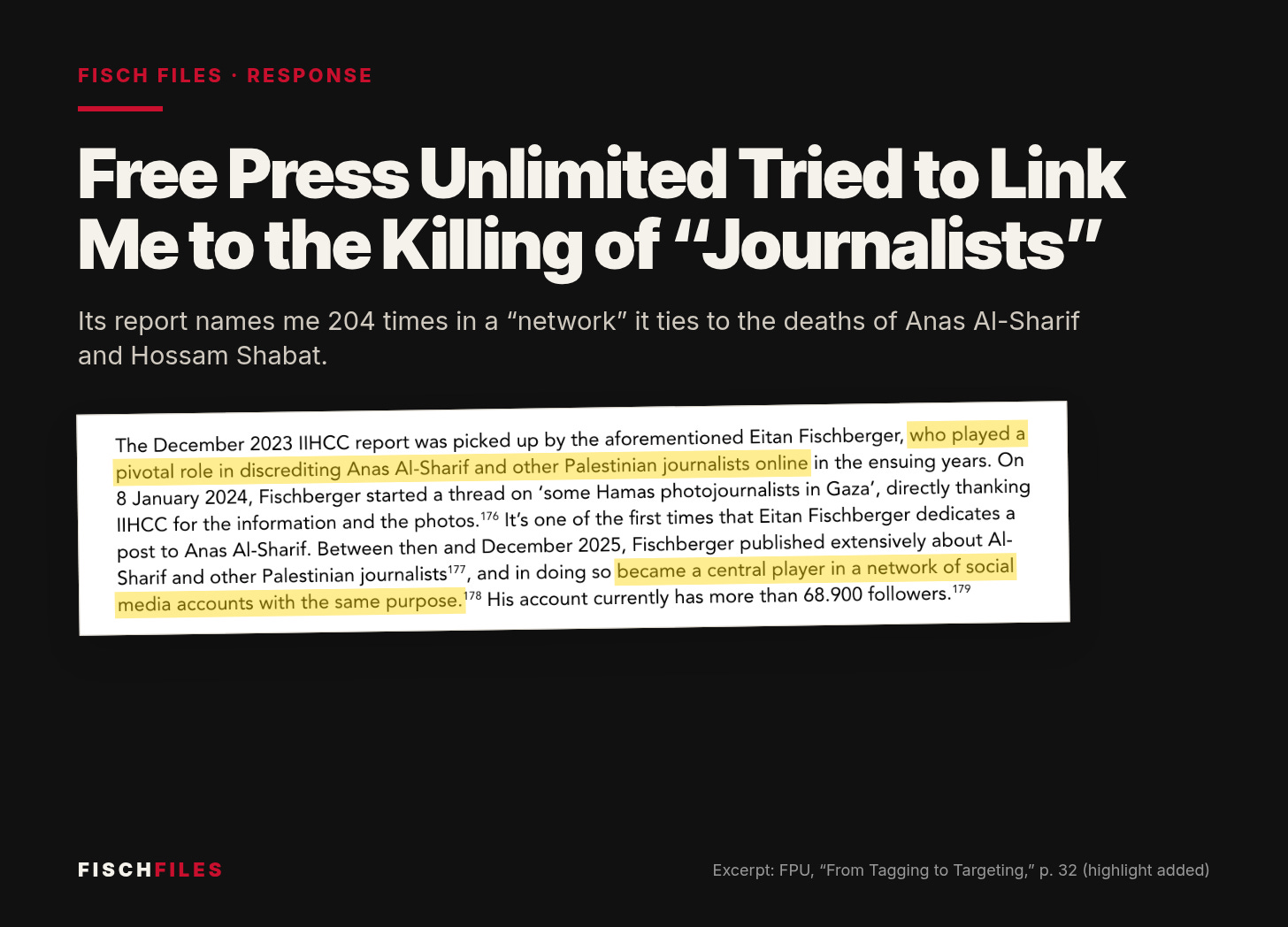
The report names me 204 times and calls me “a central player in a network of social media accounts” that discredited Al-Sharif and other Palestinian journalists (p. 32).
The work FPU objects to is my October 22, 2024 thread on Al-Sharif, which FPU itself says “consists predominantly of posts from Al-Sharif’s own social media accounts” (p. 36), including his October 7, 2023 Telegram posts celebrating the Hamas attack.
The report gets basic facts about me wrong. It says the Israeli Ministry of Diaspora Affairs organized a trip for me to Israel (p. 90) and a trip to Gaza (p. 28). I live in Israel, and my Gaza visit was an IDF press tour attended by reporters from The New York Times, The Wall Street Journal and AFP. It also says I “wrote a book” with Yossi Kuperwasser (p. 29), which its own appendix contradicts (p. 90).
FPU relies on the fact-checking site Misbar (pp. 28, 65, 90) without disclosing that Misbar is owned by Metafora Production W.L.L., “a private for-profit Qatari company.”
What Free Press Unlimited’s report claims
On November 19, the Dutch NGO Free Press Unlimited published From Tagging to Targeting. FPU is largely government-funded; in 2024 the Dutch government alone provided 40.5% of its income, according to its annual report.
The report is about Anas Al-Sharif of Al Jazeera, killed by Israel in August 2025, and Hossam Shabat, killed in March 2025. FPU’s thesis is that the terrorism allegations against them were built by “a network of both official actors and independent actors who (directly or indirectly) constructed and amplified delegitimisation narratives” (p. 5). It concludes that these allegations were “repeated after their deaths to justify their killing by the IDF,” and that their spread “has contributed to the state of total impunity for attacks on Palestinian journalists in Gaza” (p. 69).
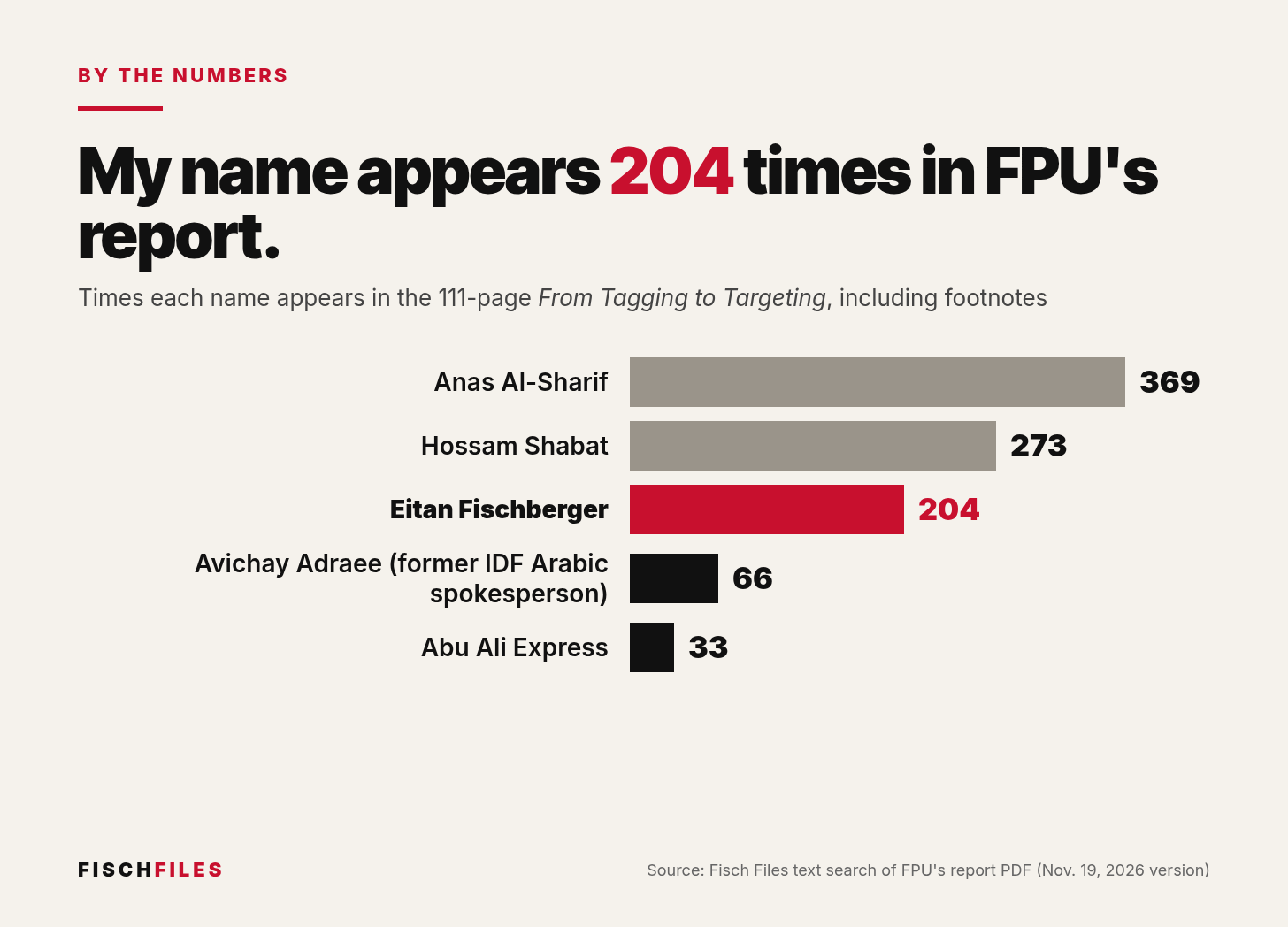
FPU puts me at the center of that network. My name appears 204 times in the report, more than three times as often as Avichay Adraee, the IDF’s former Arabic-media spokesperson, who appears 66 times. FPU writes that I “played a pivotal role in discrediting Anas Al-Sharif and other Palestinian journalists online” and “became a central player in a network of social media accounts with the same purpose” (p. 32).
What I actually did was publish Al-Sharif’s and Shabat’s own posts. FPU’s own description of my October 22, 2024 thread on Al-Sharif is that it “consists predominantly of posts from Al-Sharif’s own social media accounts” (p. 36). Those posts include his Telegram messages from October 7, 2023, which are shown below.
FPU contacted me before publication, and I answered in writing. FPU posted my response on its methodology page, then published claims about me that my response had already corrected. The errors are set out below.
Drop Site News’ Ryan Grim made the same accusation
This isn’t the first time someone has tried to link me to the killing of “journalists.” In April 2026, after I called for congressional and DOJ investigations into the foreign ties of Drop Site News, its co-founder Ryan Grim replied:
“Specifically, your lies about many good journalists helped to get them executed by Israel. You knew what you were doing, and frankly you should be prosecuted as an accessory to their murder if it can be shown you collaborated in their killing.”
The next day, on April 8, 2026, he wrote:
“Did you send the IDF any names of journalists to be included in its list of targets for execution? Of course you did. Obviously you should be entitled to a fair trial but by any reasonable, conventional understanding of the term, you have been an accessory to murder.”


I have never sent the IDF the names of any journalists, and I told him so at the time.
FPU’s false claim that an Israeli ministry sent me on two trips
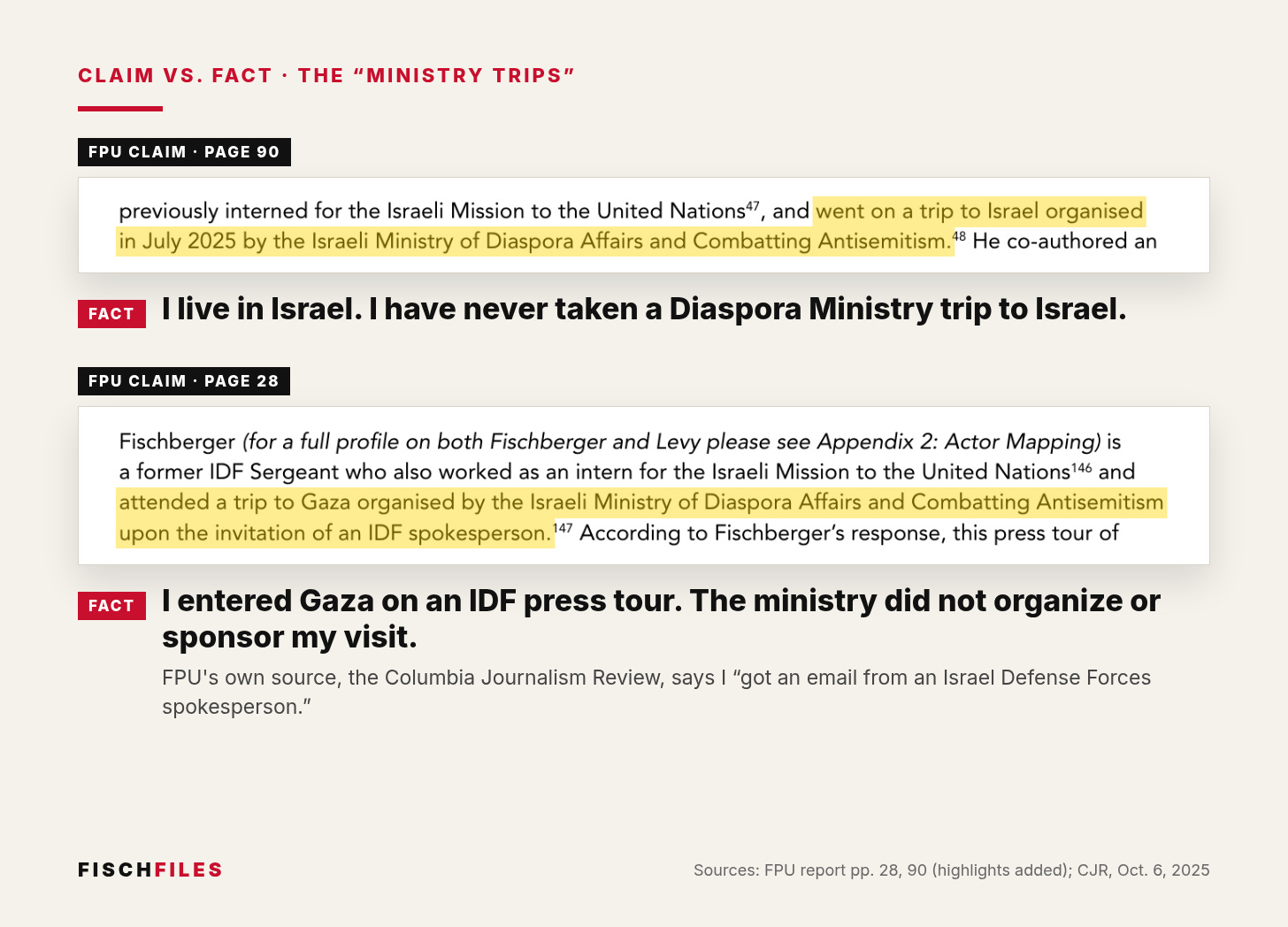
On page 90, FPU writes that I “went on a trip to Israel organised in July 2025 by the Israeli Ministry of Diaspora Affairs and Combatting Antisemitism.”
I live in Israel. I have never been on a Diaspora Ministry trip to Israel. FPU invented my attendance to this trip out of thin air.
On page 28, FPU writes that I “attended a trip to Gaza organised by the Israeli Ministry of Diaspora Affairs and Combatting Antisemitism upon the invitation of an IDF spokesperson.”
That is also false. On July 27, 2025, I entered Gaza at the Kerem Shalom crossing on an IDF press tour, alongside reporters from The New York Times, The Wall Street Journal, AFP and other outlets. The Diaspora Ministry did not organize or sponsor my visit. Nobody paid me, and nobody told me what to say.
I explained all of this to FPU before publication. The report quotes my explanation in the sentence immediately following the false claim on page 28.
Both claims cite the same source: Amos Barshad’s “Israel’s Influencer Insiders” in the Columbia Journalism Review (footnotes 48 and 147). Its first sentence reads: “In July, Eitan Fischberger got an email from an Israel Defense Forces spokesperson asking if he wanted to go to Gaza.” The article does not say the Diaspora Ministry organized my visit, and it does not mention any trip “to Israel.” The only July 2025 trip it describes is my Gaza press tour, yet FPU cites it for two separate ministry trips that I never went on.
FPU’s false claim that I wrote a book with Yossi Kuperwasser
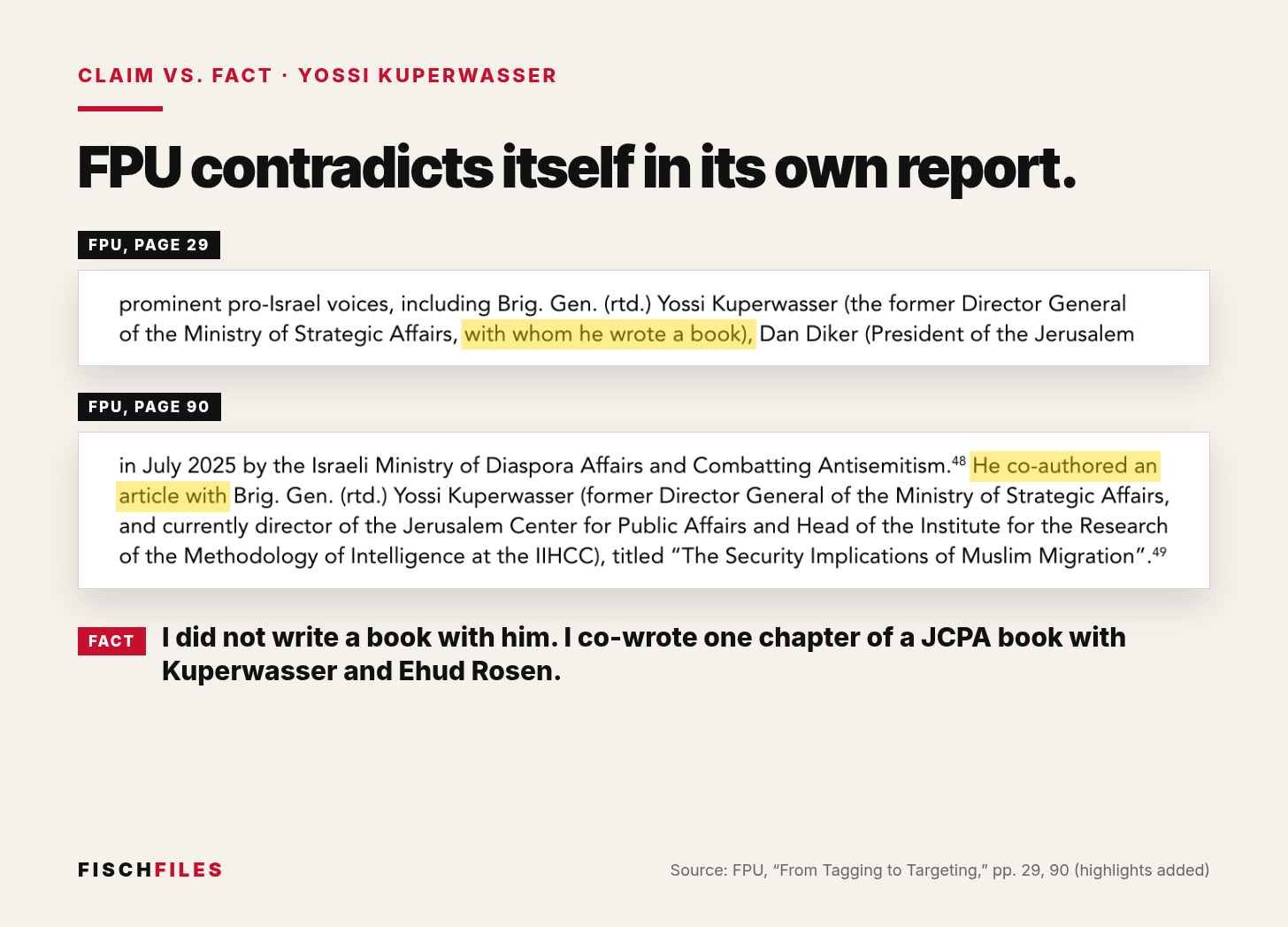
On page 29, FPU describes Brig. Gen. (ret.) Yossi Kuperwasser, former Director General of Israel’s Ministry of Strategic Affairs, as someone “with whom he wrote a book.”
That is false. I did not write a book with Kuperwasser. I wrote a chapter in a 2019 Jerusalem Center for Public Affairs book with Kuperwasser and Ehud Rosen, “The Security Implications of Muslim Migration.” FPU’s own appendix on page 90 describes it as an article: “He co-authored an article with Brig. Gen. (rtd.) Yossi Kuperwasser.” I separately contributed to a different book.
FPU’s reliance on Misbar, and what it didn’t tell readers
FPU relies on a September 14, 2025 article by the website Misbar, “How Eitan Fischberger Uses Open-Source Tools To Promote Israeli Propaganda,” to characterize my work. It quotes Misbar on pages 28 and 90 and cites it on page 65 as the source for the statement that “Fischberger regularly undermines the legitimacy of Palestinian journalists through open-source investigations.”
Misbar’s article gets basic facts about me wrong. It says I leverage my “journalistic background.” I have never worked as a journalist. It calls me a “former military censor.” I have never been one. It says I rely on “leaked conversations from private Telegram groups.” I have never done that.
I told FPU all of this before publication. FPU printed my objections on page 91 and relied on Misbar on pages 28, 65 and 90 anyway. The report does not say whether FPU verified any of Misbar’s claims, and it does not tell readers who owns Misbar.
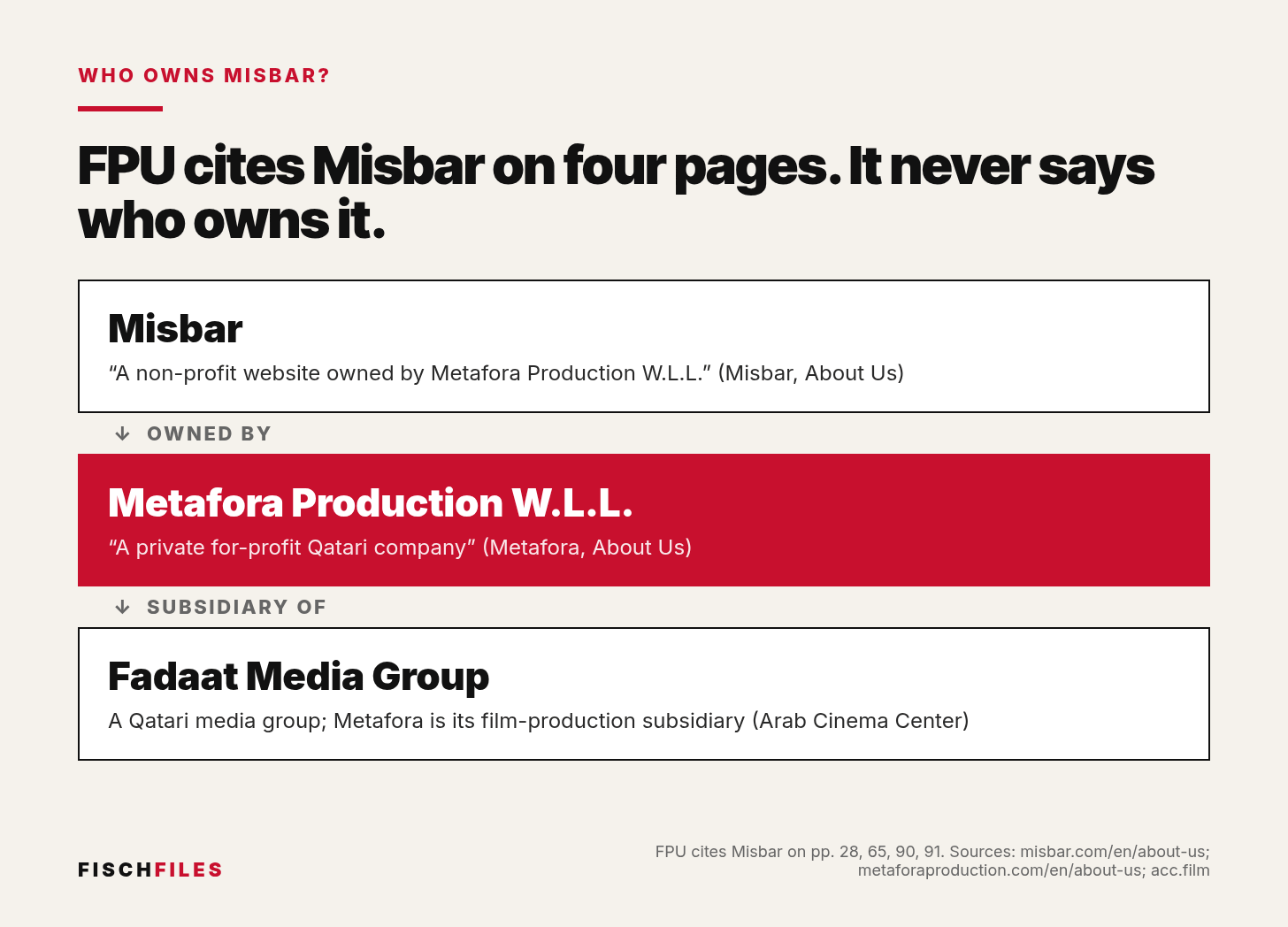
Misbar’s own About page says it is “a non-profit website owned by Metafora Production W.L.L.” Metafora’s website describes the company as “a private for-profit Qatari company.” Metafora’s general manager, Moayed Dib, has been CEO of the Qatari Fadaat Media Group since 2012, and Metafora is that group’s film-production subsidiary. The report mentions Misbar 16 times and never mentions Metafora or Misbar’s Qatari ownership.
The report does not give Misbar the context it asks of others. On page 64, FPU criticizes outlets that “cited pro-Israel voices without providing context on their affiliations,” and on page 66 it notes that Al Jazeera is “primarily funded by the Qatari state.”
What Anas Al-Sharif posted on October 7
FPU describes my work on Anas Al-Sharif as “smears.” Everything in my October 22, 2024 thread came from Al-Sharif’s own accounts. FPU’s report acknowledges this: it says the thread “consists predominantly of posts from Al-Sharif’s own social media accounts” (p. 36).
On October 7, 2023, while Hamas terrorists were carrying out the massacre in southern Israel, Al-Sharif posted on Telegram:
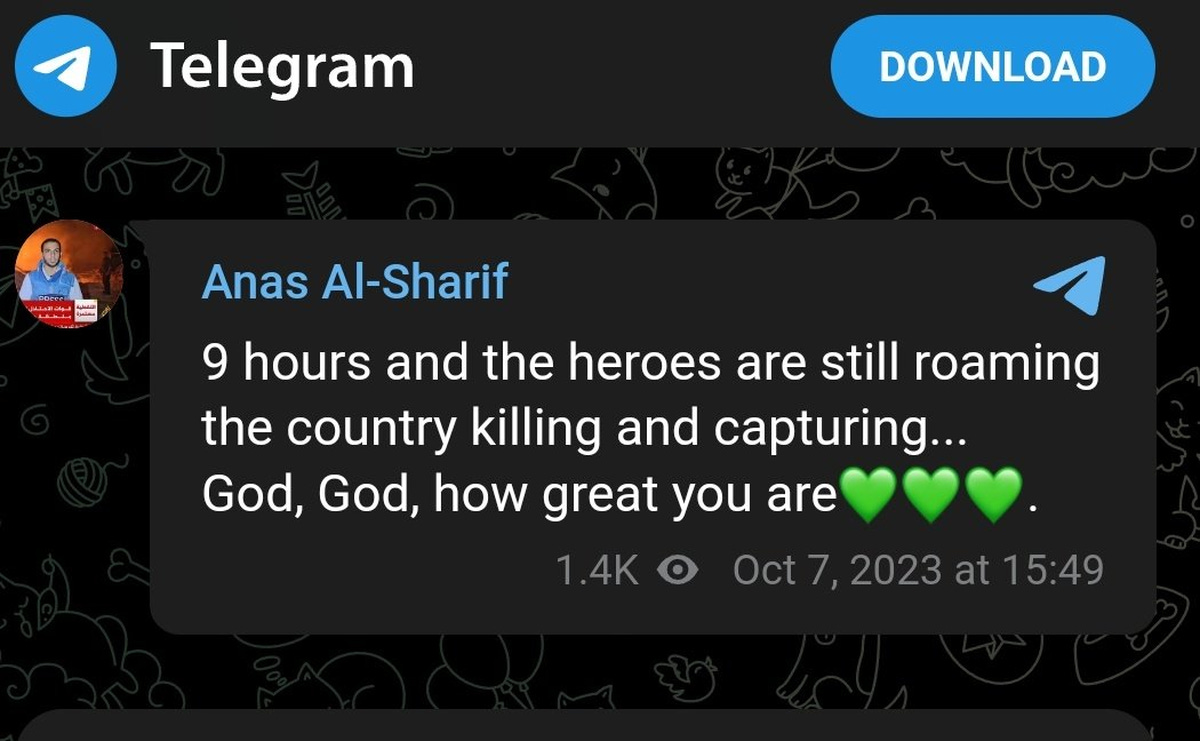
“9 hours and the heroes are still roaming the country and killing and capturing...God, God, how great you are”
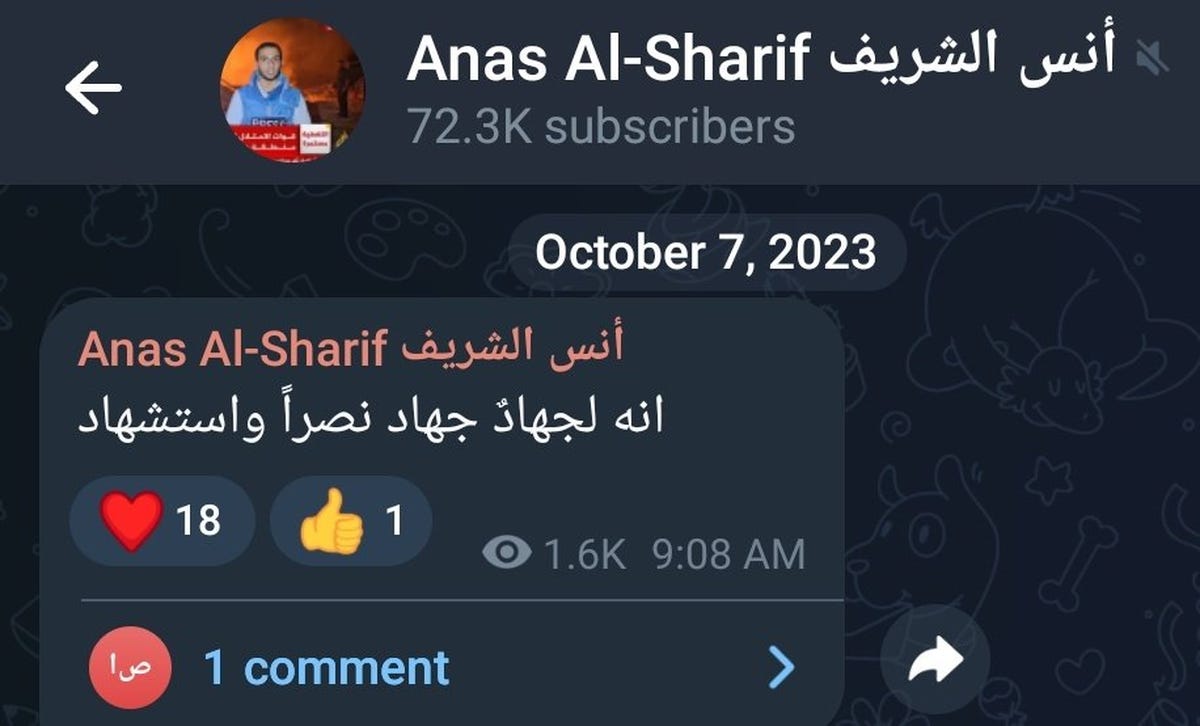
“It is a struggle, a struggle of victory and martyrdom”
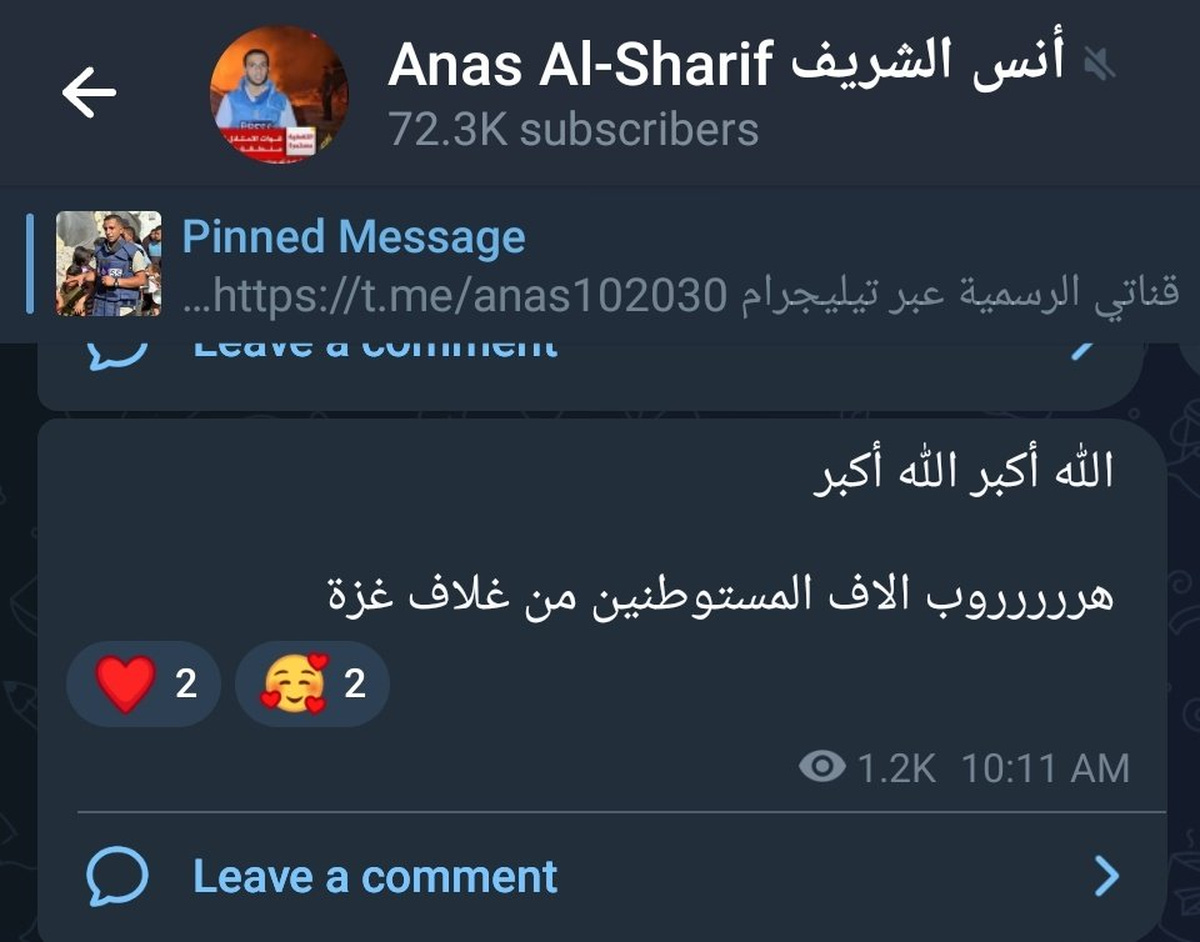
“God is Great God is Great
Thousands of settlers fled the Gaza Strip”
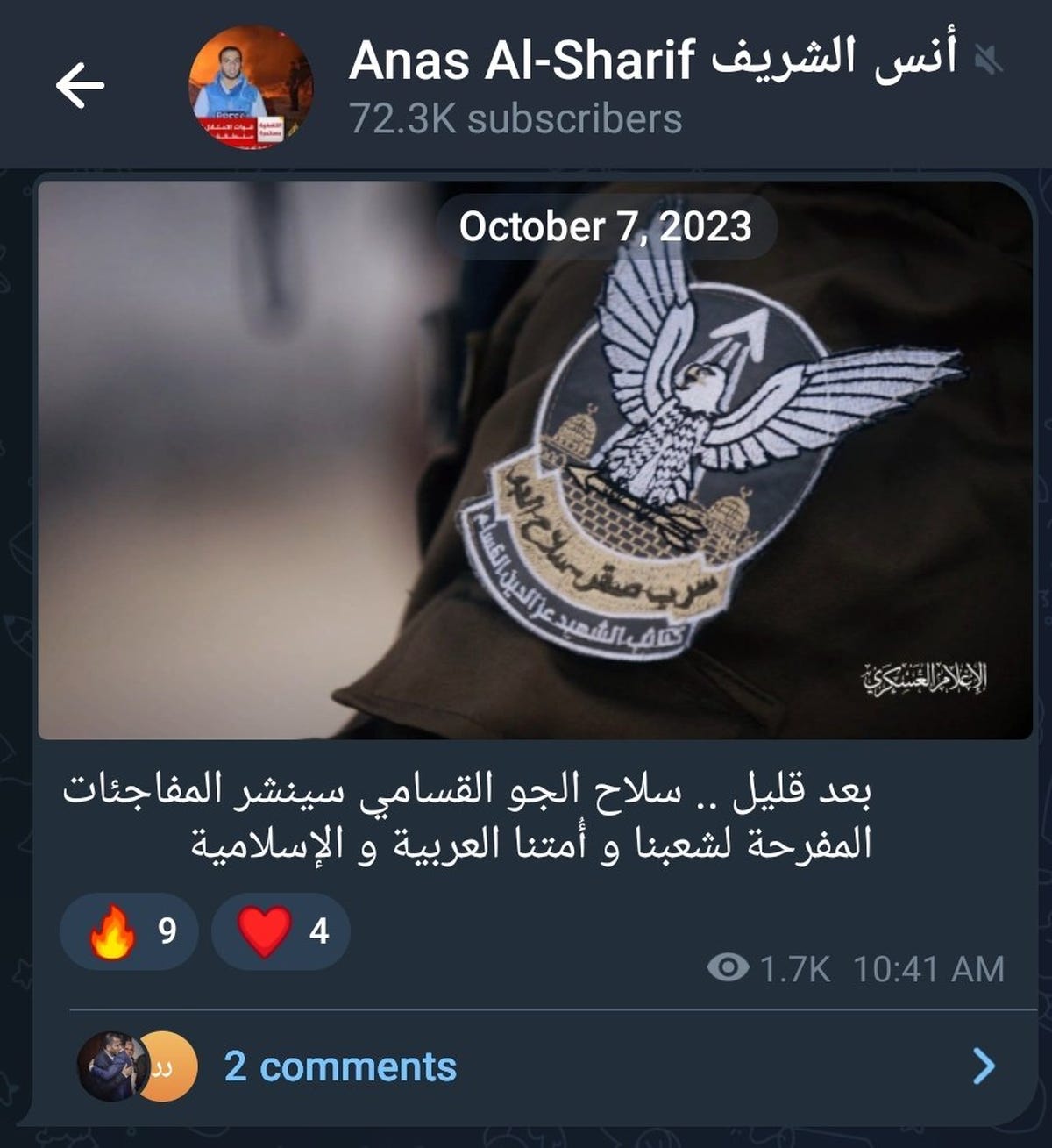
“Soon, the Qassam Air Force will spread happy surprises to our people and our Arab and Islamic nation”
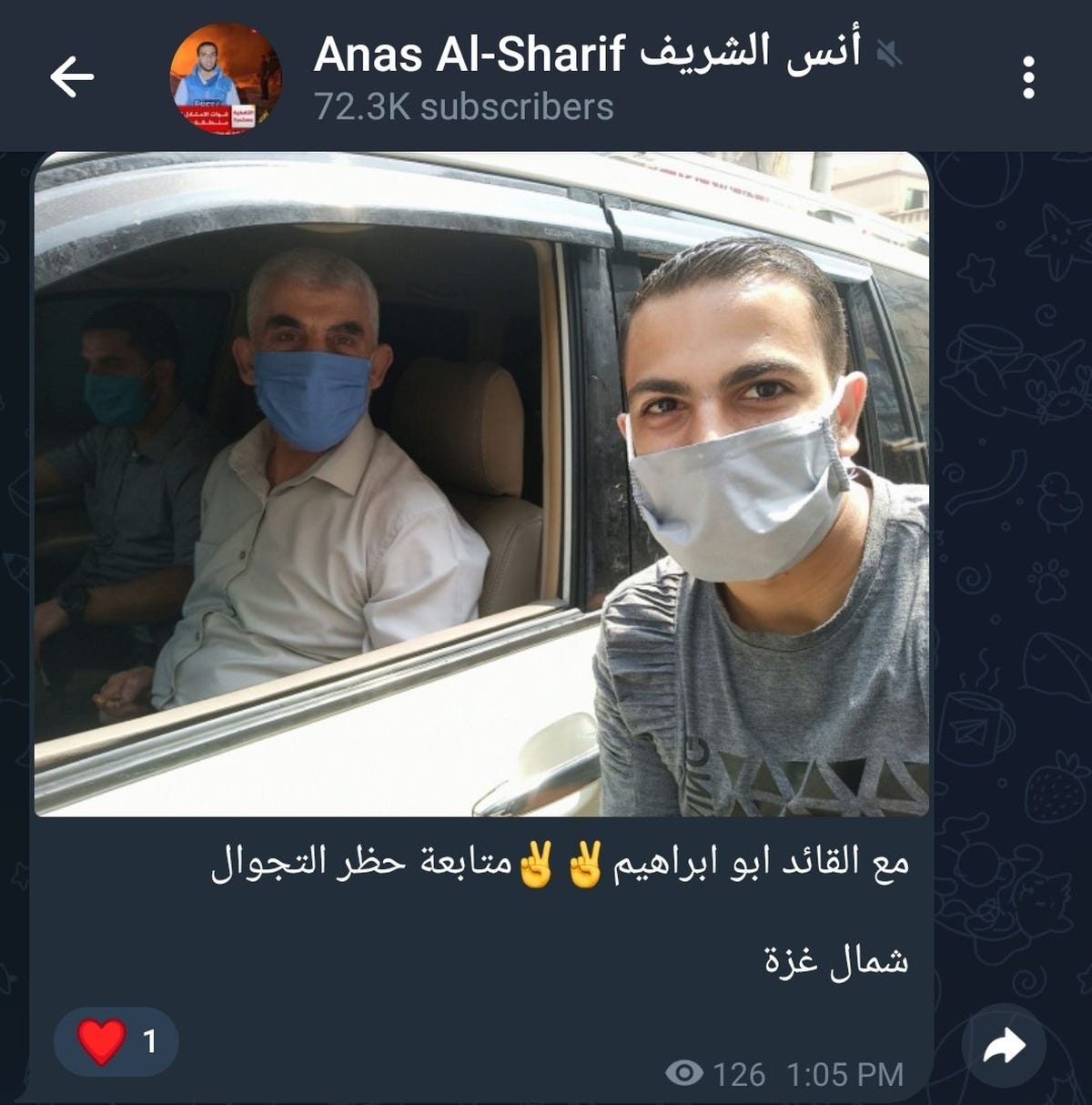
The same thread showed Al-Sharif posing in 2020 with Hamas leader and October 7 mastermind Yahya Sinwar, with Hamas co-founder Mahmoud al-Zahar in 2017, and his own post thanking Hamas politburo member Fathi Hamad for visiting his home:
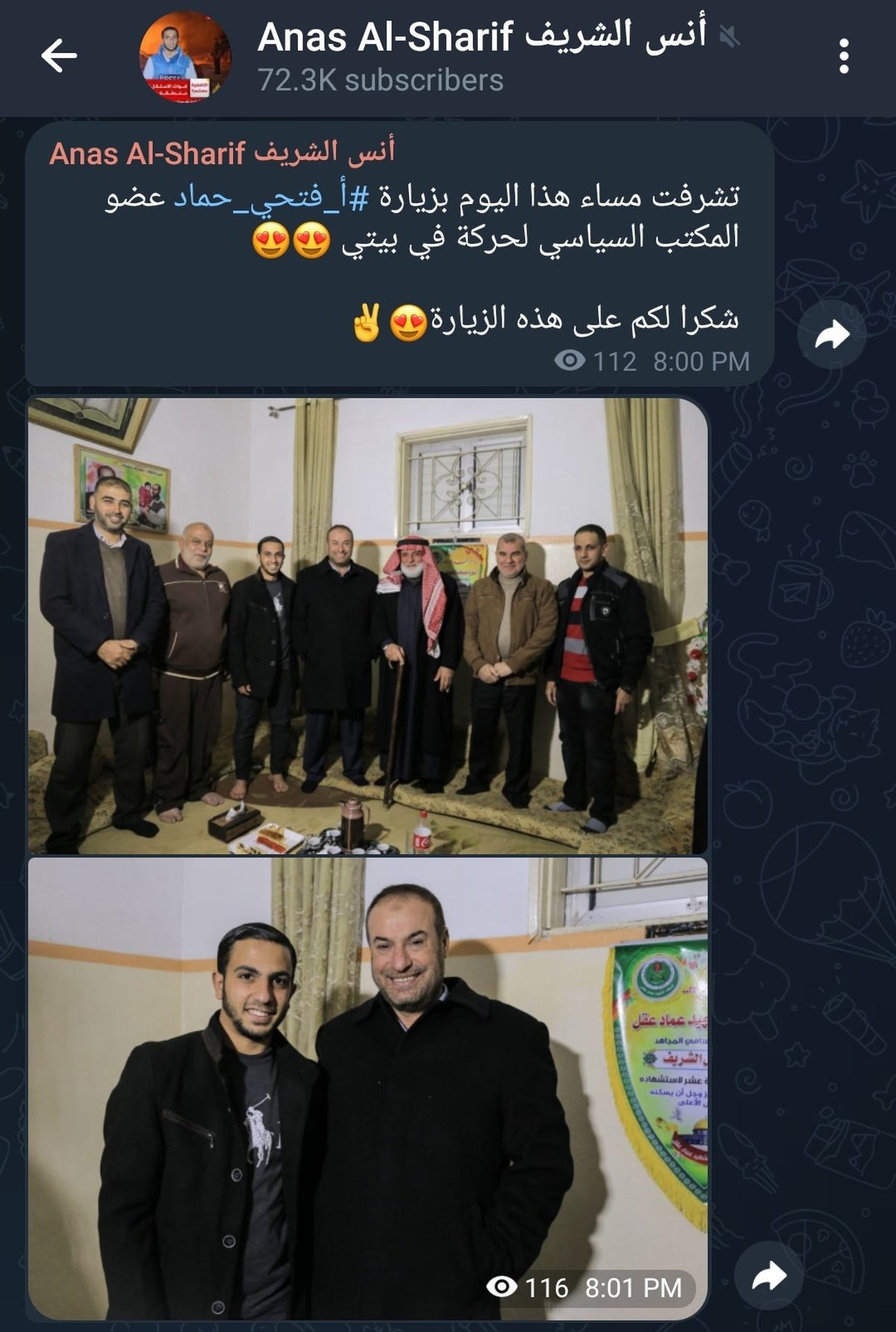
“I had the honor this evening of receiving a visit from # Mr._Fathi_Hammad, a member of the political bureau of the [Hamas] movement, at my home 😍😍
Thank you for this visit 😍✌”
My full response to FPU
FPU asked me to respond before publication. Below is my response in full, followed by FPU’s invitation with every statement and question it sent me. Both appear exactly as in the PDF FPU published.
MY ANSWER:
Thank you for reaching out. My answers to your statements and questions follow, in order. I ask that FPU publish this response in full, or quote it without edits that change its meaning, and link to it from the report.
I’ll start by noting that your email to me makes quite a few references to international law. I am not a lawyer, so I’ll leave those questions to legal experts. UN Watch, for example, notes that under the ICRC’s own guidance, a member of an armed group with a “continuous combat function” does not become a protected civilian by working as a journalist (https://unwatch.org/legal-analysis-of-francesca-albaneses-october-2026-report/). And as the Lieber Institute at West Point has explained, Israel, like the United States, rejects even that narrower test and treats membership in Hamas’s military wing as sufficient for status-based targeting (https://lieber.westpoint.edu/inside-idf-targeting/). I’m not trying to debate international law with you, but I did feel the need to note this before you read my answers, since it was important to me that you understand these perspectives, with which I generally agree.
Also, just a quick word about me, so my background and work aren’t misrepresented:
I am an independent OSINT researcher and analyst. I am not paid by the Israeli government, the IDF, or any ministry. I have never had a paid collaboration with any of them, and I do not coordinate my work or my messaging with them. My only interaction with the IDF in connection with my investigative work was a press tour of Gaza, attended by reporters from The New York Times, The Wall Street Journal, and AFP, among others. Nobody paid me for it, and nobody told me or suggested to me what to say about it. Everything I publish comes from open sources and is posted publicly with screenshots, links, or both attached, so anyone can check it. Writing 25 posts about Anas Al-Sharif and 19 about Hossam Shabat does not make me part of a “network.” It makes me thorough.
I would also like to note, on the record, that the so-called “delegitimization of Palestinian journalists,” which I see is the primary focus of your report, is not done by OSINT investigators like me or even by the Israeli military. Rather, it is done by people who sit idly by as the sanctity of journalism is tarnished by people who wear it like a skin suit to pursue a particular political agenda. In the cases of Anas Al-Sharif and Hossam Shabat, an agenda of violence. Anas and Hossam were the ones who delegitimized journalism. And I’m trying to show the world how they did it.
I find it almost humorous, in a depressing sort of way, how stunningly little many in the media seem to care about the integrity of their own profession. Watching many in the media and alleged press-freedom groups bend over backwards to defend men who quite literally celebrated on October 7, as women and children were savagely butchered in their homes, called the terrorists who invaded Israel “heroes,” and explicitly called for the murder of Jews does profound, irreparable damage to the profession they claim to protect.
Real journalists in Gaza, who are silenced by Hamas, and journalists everywhere else deserve better than to be lumped in with the likes of Anas Al-Sharif, Hossam Shabat, and the other terrorists masquerading as “journalists” in order to hoodwink gullible Westerners who will act as their stenographers. My hope is that the research I do helps, even just a little, expose the deep-seated rot that has infected so much of the media-industrial complex, so that it can begin to heal.
Anyways, on to the substance of your report and how it addresses me and my work.
“Attacking Hossam Shabat”
Being “among the first” is not the criticism you think it is. My 24 March 2024 thread opened with the claim of mass rapes at Shifa Hospital that Shabat was promoting. Al Jazeera deleted that testimony within a day, and its former managing director, Yasser Abu Hilalah, wrote that “Hamas investigations” had found the story fabricated.
On the vest, read what I wrote. I said he “occasionally” reported without one, which already acknowledges that he usually wore it. There was nothing to omit. On his employer, I showed that his profiles did not clearly name his outlet and that the outlet’s name appeared blurred out on his Hamas government-issued press badge.
The same thread showed he launched a Telegram channel at 6:50 a.m. on October 7, minutes into the massacre, and posted images of it all day, along with laughing emojis and descriptions of the attackers as “heroes.” In October 2024, the IDF named him as a sniper in Hamas’s Beit Hanoun Battalion.
EylON the Record
I stand by what I said. The IDF does not always publish the evidence behind its allegations, as doing so could potentially endanger its sources in Gaza. This is exactly why open-source work matters. The IDF’s case rests on internal Hamas records, testimonies, and other material that militaries are under no general obligation to divulge publicly (even if I wish they would).
My work rests on what these men published themselves, in public. That is what contemporaneous evidence means. When a man listed in Hamas records as a military operative also spent October 7 celebrating the attack and posed with Hamas leaders, those records become more believable, not less. My work was never meant to replace the IDF’s documents. But it does complement them.
I’ve published numerous examples showing the value of open-source research. For example, there was a Palestinian “journalist” named Rizq Abu Shakian, who was killed on July 6, 2024. According to CPJ, Abu Shakian worked as a media worker for the “pro-Hamas Palestine Now Agency.” But Hamas-affiliated Telegram channels told a different story. Videos and memorial posts identify him as a fighter in the Al-Qassam Brigades and commemorate him as a “mujahid.” He appears on camera in full Qassam Brigades uniform, holding a machine gun and reciting some jihadist chants.


The Committee to Protect Journalists eventually removed Abu Shakian from its list of journalists killed in Gaza after its own subsequent research established that he had engaged in combat (https://cpj.org/2023/10/journalist-casualties-in-the-israel-gaza-war/).
Even more disturbing was the case of Abdullah Aljamal. When he was killed by the IDF in June 2024, he was instantly mourned as a Gazan journalist unjustly killed by the IDF. Upon hearing the news, I quickly searched online and found that he was indeed a “correspondent” for The Palestine Chronicle, but that he was also tied to Hamas and even worked for several of its ministries. I quickly posted this on X.
Soon after, the IDF confirmed that Abdullah had been holding three Israeli civilian hostages in his home, who had been abducted on October 7, and that he was killed during an IDF mission to rescue those hostages (https://redstate.com/jenvanlaar/2024/06/09/confirmed-journalist-in-gaza-who-wrote-for-us-based-ngo-housed-three-israeli-hostages-in-his-home-n2175247). The hostages themselves confirmed that they had been held at his family’s home and are now suing in federal court over it.
Those are just two examples of the value of open-source research.
“Smears” About Anas Al-Sharif
I reject the word. A smear is a false claim. What I published about Anas Al-Sharif was his own material. My 22 October 2024 thread showed his Telegram posts from October 7, 2023, where he wrote, “It is a struggle, a struggle of victory and martyrdom,” and “9 hours and the heroes are still roaming the country and killing and capturing... God, God, how great you are”.

I also posted photos of him with Yahya Sinwar, a 2017 photo with Hamas co-founder Mahmoud al-Zahar, and his own post thanking Hamas politburo member Fathi Hamad for visiting his home.
The IDF, for its part, later published personnel rosters, training lists, and salary records naming him as a rocket-squad commander in Hamas’s East Jabalia Battalion. I had no advance knowledge of the IDF’s announcement. The timing was a coincidence, and I pointed it out myself, publicly, the next day.
What prompted my thread is in the thread itself. The second post is a screenshot of one of Al-Sharif’s posts that had 10.5 million views. When I saw a propagandist with his record reaching an audience that size, I decided it was time to show people who he really was. He was the dominant voice reporting from Jabalia, and the thread also showed AP, Reuters, and The New York Times amplifying him.
Misbar’s Coverage of Me
I would be hesitant to use Misbar as a source for your coverage of me and my work. For a “fact-checking platform,” it seems to have a rather flimsy grasp of facts.
For example, its report about me that you reference says that I “leverage my journalistic background.” But I have never worked as a journalist. It also states that I am a “former military censor,” which is completely made up. I have absolutely no idea what they’re talking about.
Finally, Misbar writes that I have relied on “leaked conversations from private Telegram groups,” which I have never done.
I’ve read Misbar’s full article again and am struggling to identify a single instance, even in their own investigation, where they demonstrate that I’ve fabricated a screenshot, invented a quote, or manufactured evidence. Instead, they repeatedly accuse me of publishing “misleading” information, largely because they disagree with my interpretations of material that they cannot establish is false.
Misbar says I chose a handful of posts out of more than 43,000 on Al-Sharif’s Telegram channel.
Yes, that is how evidence works.
You do not need 43,000 posts to show a man celebrating murder. You need one.
Closing Remarks
If you’re already mentioning me in the report, you can feel free to note not just Anas Al-Sharif and Hossam Shabat, but also the dozens of other “journalists” whom I’ve exposed as either propagandists for U.S.-designated terrorist organizations or terrorists themselves.
I am happy to send links. It would save your researchers some time.
FPU’s invitation to respond
The invitation for response as sent by Free Press Unlimited:
Dear Mr. Fischberger,
In response to our communication on Linkedin, please find the additional information on our report below. We kindly invite your response to findings we will publish in a forthcoming report about the delegitimisation of Palestinian journalists before and after they were killed, in particular the cases of Anas Al-Sharif and Hossam Shabat. I have posted the full text below, and added any hyperlinked sources in-text so you can access them without needing to click any of the links.
To ensure that we accurately reflect any views or actions taken by you in relation to the matters included in the report, we respectfully request your response by 16 November 2026. Please find a summary of the key findings of the report below, followed by statements and questions to which we invite your response.
Summary of key findings
The report analyzes public and online statements in which official and independent actors have referred to the two Palestinian journalists as terrorists, propaganda operatives, or participants in hostilities without providing credible evidence of these allegations. In the report, we refer to these allegations as ‘delegitimisation narratives’: efforts beyond legitimate media criticism, in which journalists are portrayed in a way that discredits their status as a journalist or their journalistic credibility, without providing credible evidence of such allegations. FPU conducted digital and open source research to answer the research questions: ‘How have delegitimisation narratives around killed Gazan journalists been constructed?’ and ‘How did these narratives reach legacy media – and thereby large audiences?’.
With regard to the allegations issued against Anas al Sharif and Hossam Shabat, the report outlines the applicable legal framework under international humanitarian law, which prescribes that journalists can only be legitimate targets during armed conflict if and for so long as they participate directly in hostilities. The report finds that the IDF provided no credible evidence that meets this threshold, nor that supports the allegations made in these two cases. The report notes, among others, that the screenshots the IDF distributed to substantiate its allegations were unverifiable due to Israel’s refusal to release the original documents, remain uncorroborated, and do not contain evidence relevant to the applicable legal threshold (both in time and scope).
With regard to materials shared by other actors, including photos of the journalists with leaders of a terrorist organisation or posts from their social media accounts, the report notes in reference to the applicable legal framework (including the interpretation by the Israeli authorities) that the mere expression of political thoughts or (alleged) sympathies with a party to the conflict are not sufficient to demonstrate that a journalist has ‘participated directly in hostilities’, and thereby do not justify any attacks against them.
To research the aforementioned questions, the report relies on two methods: a chronological reconstruction of the delegitimisation campaigns that targeted Anas Al-Sharif and Hossam Shabat, analysing social media activity, official statements, thinktank publications and other publicly available material. Second, an examination of 98 publications from 14 major legacy media outlets across seven Western countries to assess how allegations against the two journalists were reported.
The first key finding is that delegitimisation narratives about Al-Sharif and Shabat were constructed and amplified through a specific network of both official actors, meaning (individuals employed by) the IDF and other Israeli government bodies, and independent actors. Our findings show that actors in- and outside the Israeli government and IDF reinforced each other’s messaging about the journalists by reposting and adding to the same narratives, exchanging information about the journalists (e.g. OSINT-researchers handing over ‘evidence’ to the IDF and meeting with IDF officials), attending meetings organized by government bodies in which messaging was coordinated, and in some cases, even engaged in paid collaborations with Israeli ministries. In both cases, our analysis demonstrates that delegitimisation followed a recognisable pattern, moving from allegations of propaganda to allegations of terrorism.
During periods of heightened international criticism of Israeli military operations, delegitimisation activity intensified considerably. Second, our analysis of legacy media demonstrates that these narratives were frequently reproduced by international legacy media in ways inconsistent with fundamental journalistic safeguards. Despite the severe nature of the allegations, for example, more than 72% of the publications about Al-Sharif and Shabat did not demonstrate any attempts to independently verify allegations of terrorism made against the journalists. While the severity of these shortcomings varied, together they contributed to the wider dissemination and normalisation of these unsupported and severe allegations.
The report argues that insight into delegitimisation is relevant because the protection of journalists in armed conflict is contingent on their status as civilians. Accusations of participation in combat or terrorism can influence how the legitimacy of attacks on journalists is assessed and can thus impact accountability for violations of international humanitarian law.
In the publication, we make the following statements, for which we would like to invite your response:
In reference to at least 25 posts on your account on X about Anas Al-Sharif, and 19 about Hossam Shabbat, the report identifies you as one of the (independent) actors who became a central player in ‘a network of official and independent actors who were involved in constructing and amplifying delegitimization narratives’ about Palestinian journalists and their work.
The report refers to a publication by the Committee to Protect Journalists in July 2025, in which the organization expresses its worries about ‘an Israeli military smear campaign’ which Al-Sharif believed to be ‘a precursor to his assassination’. The report notes that you were among the online actors that published smears of Al-Sharif in this period before his death, including following his video on 20 July 2025, as well as after his killing in August 2025. (link: https://cpj.org/2025/07/cpj-calls-for-anas-al-sharifs-protection-in-face-of-israeli-smears/)
With regards to Hossam Shabat, the report notes you were among the first to publicly attack him in this way, referring to your post of 24 March 2024.

With regard to your post on 24 March 2024, the report notes, in response to your commentary on the lack of a press vest in two photos of Shabat on Facebook, that (regardless of the fact that press vests are not obligatory for journalists), you omitted that Shabat regularly posted photos in which he wears this vest. With regards to your allegation that Shabat was ‘coy’ about his employer, the report similarly points at posts in which Shabat refers to Al-Jazeera.
In a profile of your work and career, the report notes, among others and in reference to your publications or biographies online, that you previously interned for the Israeli Mission to the United Nations and worked for the organizations CAMERA (as an on-campus coordinator between 2019 and 2021) and NGO Monitor (between August 2021 and February 2022).
In relation to our findings, we also have three specific questions:
In a podcast by Eylon Levy (EylON the Record - Israel: State Of A Nation - Hamas’ Media Training Program | How BBC & Mainstream Media Fall For Lies) you noted that your posts contain ‘contemporaneous evidence’ which ‘give more credence to the IDF’s allegations’, for which the IDF, according to you, ‘on some occasions do not provide the evidence to back it up’. In the report, we find that the materials referenced in your posts about Anas Al-Sharif and Hossam Shabat do not provide evidence of the allegations made by the IDF, which extend to allegations of terrorism and allegations of holding positions in Hamas’ military wing. Why do you argue that your findings add credence to the allegations of the IDF?
You published a post on X on 22 October 2024 about Anas Al-Sharif and his work. This was published one day before the IDF published its allegations against Anas Al-Sharif of involvement in terrorism on X (23 October 2024). In your post, you specifically noted “Meet Al Jazeera’s Anas Jamal Al-Sharif, the most prolific “journalist” left in North Gaza. Pretty much every piece of propaganda coming from Jabalia originates with this monster.” What prompted your thread about Anas Al-Sharif on 22 October?
In 2025, factchecking platform Misbar published an article titled ‘How Eitan Fischberger Uses Open-Source Tools To Promote Israeli Propaganda’. What is your response to the allegations made in this article, including the conclusions that your posts ‘show a pattern of cherry-picking evidence, generalizing, and dehumanizing - especially field journalists - by implying official ties to Hamas without concrete proof’, ‘often appeal[s] to emotions to boost engagement’ and ‘not only repeats the official narrative but also legitimizes it by backing it with supposed open-source investigations, which ultimately recycle the same talking points in a more persuasive form for his audience’? (link: https://www.misbar.com/en/editorial/2025/09/14/how-eitan-fischberger-uses-open-source-tools-promote-israeli-propaganda)
Any response received before November 16th will be incorporated in the report. If you have any questions, please contact me at [email address].
I will update this post if FPU corrects the report.
Eitan Fischberger is an independent OSINT analyst who researches the anti-Israel, anti-Western information and influence ecosystem. He publishes his investigations at Fisch Files and posts daily findings on X at @EFischberger.
This article was written with the help of A.I.